
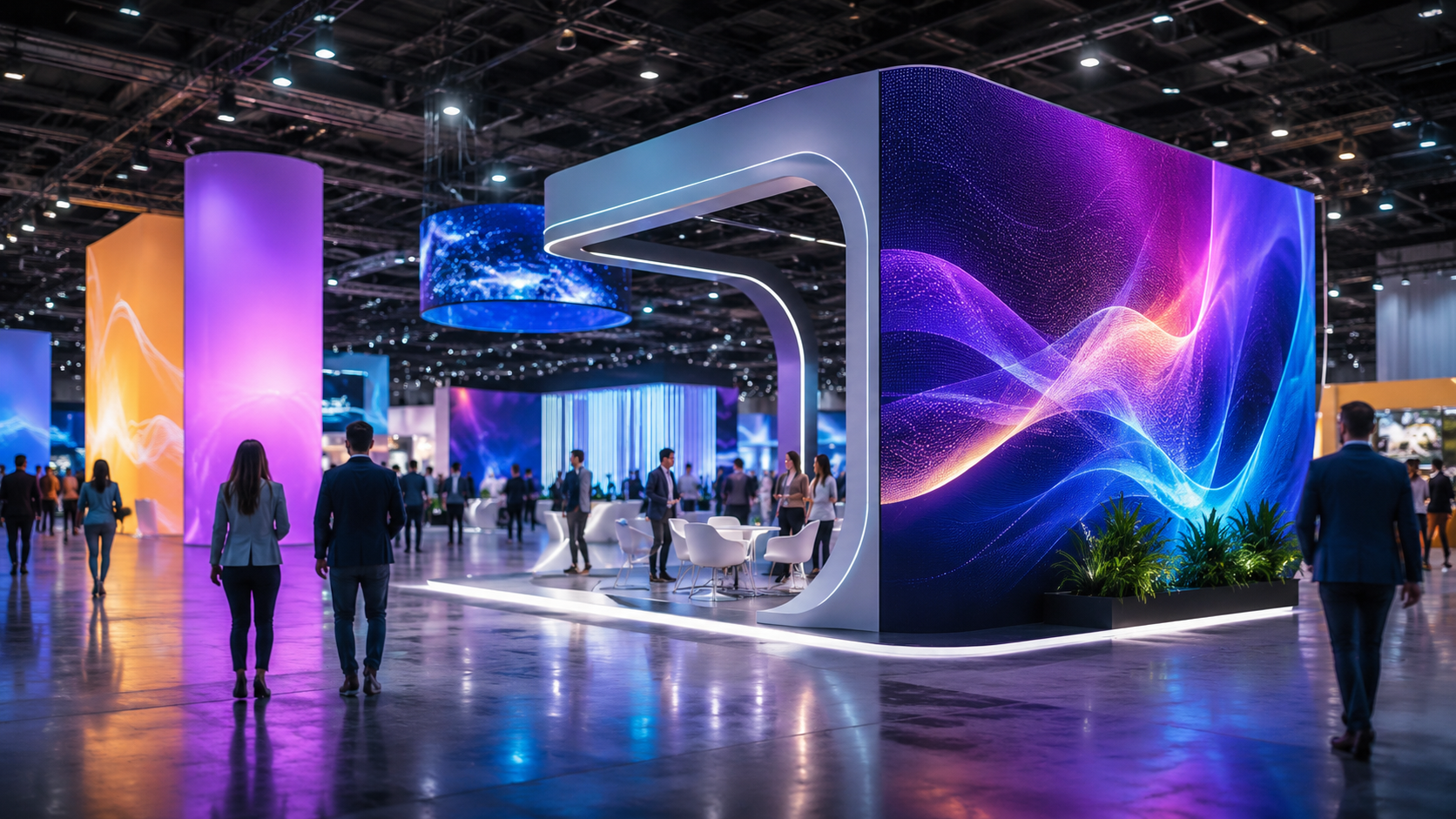
How Signage Is Changing at Trade Shows and Conferences
Event signage is no longer just a graphic support. At today’s European trade shows, signage works as a communication, wayfinding, and lead-generation system that directly influences brand perception and business opportunities.
That is why discussing the future of event signage means analyzing how design, technology, production, and visitor behavior are evolving at the same time. Trade show and conference attendees receive thousands of visual stimuli in just a few hours. In that context, signage can no longer be limited to displaying a logo or a static message. It must adapt, interact, and create a clear, memorable experience.
Within the Trends and Future cluster, this article develops a complete framework to understand where signage for booths, conferences, and corporate events is heading in the coming years, and how specialized companies like Full-Expo can help turn that evolution into real results.
Operational Definition: What “Advanced Signage” Means in Events
Advanced event signage (definition): an integrated visual system that combines graphic design, wayfinding, lighting, materials, and technology to improve visibility, understanding, and the visitor experience within a trade show environment.
Difference from traditional signage:
- Before: static, decorative messages.
- Now: dynamic and functional visual systems.
- Future: connected, adaptable, data-driven signage.
The evolution is not just about using screens or LED lighting. The real shift lies in the integration of visual identity, visitor experience, and commercial performance.
The Future Framework: 5 Transformations That Will Redefine Signage
The future of event signage can be analyzed through five structural changes:
- Digitalization: integration between physical graphics and dynamic content.
- Personalization: messages adapted to specific audiences.
- Sustainability: reusable materials and optimized production.
- Interactivity: active visitor participation.
- Modularity: visual systems adaptable to multiple events.
These five trends do not operate in isolation. They combine to create booths that are more efficient, more flexible, and more results-oriented.
Digitalization: From Static Signage to Dynamic Communication
One of the most visible changes will be the growing integration of digital elements into physical signage.
Screens Integrated into Graphic Structures
Screens are no longer used only to play promotional videos. In the coming years, they will be integrated into signage and wayfinding systems to update messages in real time.
- Advantage: content flexibility.
- Impact: greater adaptability during the trade show.
Dynamic Content Based on Context
Signage will be able to adjust messages based on:
- Event schedule.
- Visitor type.
- Featured product.
- Predominant language.
This will enable more precise and relevant communication.
Personalization: More Relevant Messages for Each Visitor
The visual saturation of trade shows requires more specific communication. The future of signage points toward more segmented and less generic messaging.
How Personalization Will Evolve
- Messages by sector: industry, technology, healthcare, retail.
- Language adaptation: multilingual international trade shows.
- Micro-content: brief, contextual information.
The key will be maintaining clarity without increasing visual complexity.
Practical Example
The same booth may display different messages depending on the area of the space or the profile of the visitor interacting with the content.
Sustainability: The Push Toward More Reusable Signage
Sustainability is already an operational requirement at many European trade shows. This will directly affect signage.
Most Relevant Sustainable Trends
- Recyclable materials: lower environmental impact.
- Reusable fabric graphics: optimized transport and storage.
- Modular systems: reuse across events.
The evolution is not based only on “eco-friendly materials,” but on reducing waste and extending the useful life of the graphic system.
How It Will Affect Costs
In the medium term, reusable systems will tend to be more cost-effective than disposable, fast-production solutions.
Interactivity: From Looking at Signage to Interacting with It
Signage will no longer be exclusively visual. It will become a point of interaction.
Technologies That Will Grow in Events
- Dynamic QR codes: instant access to content.
- Touchscreens: independent product exploration.
- Mobile integration: connection between booth and smartphone.
The goal will be to reduce friction and make data and lead capture easier.
What Will Change in the Visitor Experience
- Greater autonomy.
- More direct interaction.
- More personalized experiences.
Signage will act as the interface between visitor and brand.
Modularity: The Need for Flexible Visual Systems
Companies participate in multiple trade shows with different booth sizes and configurations. That is why modularity will become a dominant trend.
What Modular Signage Involves
- Interchangeable graphics.
- Reusable dimensional signs.
- Systems adaptable to different formats.
This improves both operational efficiency and budget control.
The Future of Dimensional Signs and Wayfinding
Dimensional signs will remain one of the most effective elements for creating visual impact, but they will evolve toward lighter and more technology-driven systems.
Expected Trends
- Invisible LED integration.
- Lighter materials.
- Reusable premium finishes.
Wayfinding will also evolve toward more intuitive visitor flows and stronger user experience.
How Graphic Design Will Change in Event Signage
Graphic design will move toward more minimalist and functional communication.
Principles That Will Dominate
- Less text.
- Stronger visual hierarchy.
- Instantly understandable messages.
In a high-speed visual environment, clarity will matter more than aesthetic complexity.
Comparison: Traditional Signage vs. Future Signage
- Static vs. dynamic
- Decorative vs. functional
- Disposable vs. reusable
- Passive vs. interactive
- Generic vs. personalized
How to Prepare for the Future of Event Signage
1) Design with Reuse in Mind
Modularity will reduce costs and increase flexibility.
2) Integrate Technology Strategically
Technology should improve the experience, not complicate it.
3) Prioritize Visual Clarity
Simple messages will be more effective.
4) Think About the Visitor Experience
Signage should guide, explain, and facilitate interaction.
How Full-Expo Can Help You Evolve
The future of signage requires integrating graphic design, advanced production, and trade show experience. Full-Expo develops solutions adapted to this evolution:
- Modular and reusable signage.
- High-visibility dimensional signs.
- Technology integration in booths.
- Graphic design focused on lead generation.
The goal is not only to build a visually attractive booth, but to create a communication system prepared for the demands of today’s and tomorrow’s European trade shows.
Mistakes That Will Limit Signage in the Coming Years
- Continuing to use excessively long messages.
- Ignoring modularity.
- Using technology without a clear function.
- Not adapting signage to international visitors.
Conclusion: The Future of Signage Will Be More Strategic and More Integrated
The future of event signage will not simply consist of adding more screens or lighting. The real change will be the integration of visual communication, visitor experience, and business goals.
Companies that understand this evolution will be able to stand out in increasingly competitive trade shows. Those that continue using static and inflexible visual systems will lose their ability to capture attention and generate opportunities.
In this new landscape, working with specialists like Full-Expo makes it possible to develop solutions prepared for both the present and the future of the European trade show industry.
Frequently Asked Questions About the Future of Event Signage (FAQs)
It will be more digital, modular, interactive, and focused on the visitor experience.
Technology integration, personalization, sustainability, and reusability will be the main trends.
Not completely. The most common approach will be the integration of physical and digital elements.
Reusable materials, technical textiles, and lightweight solutions with lower environmental impact.
Because it makes it possible to reuse structures and adapt signage to different trade show formats.
With clear messages, hierarchical design, and technology integrated in a functional way.
It will support interaction, personalization, and dynamic content updates.