
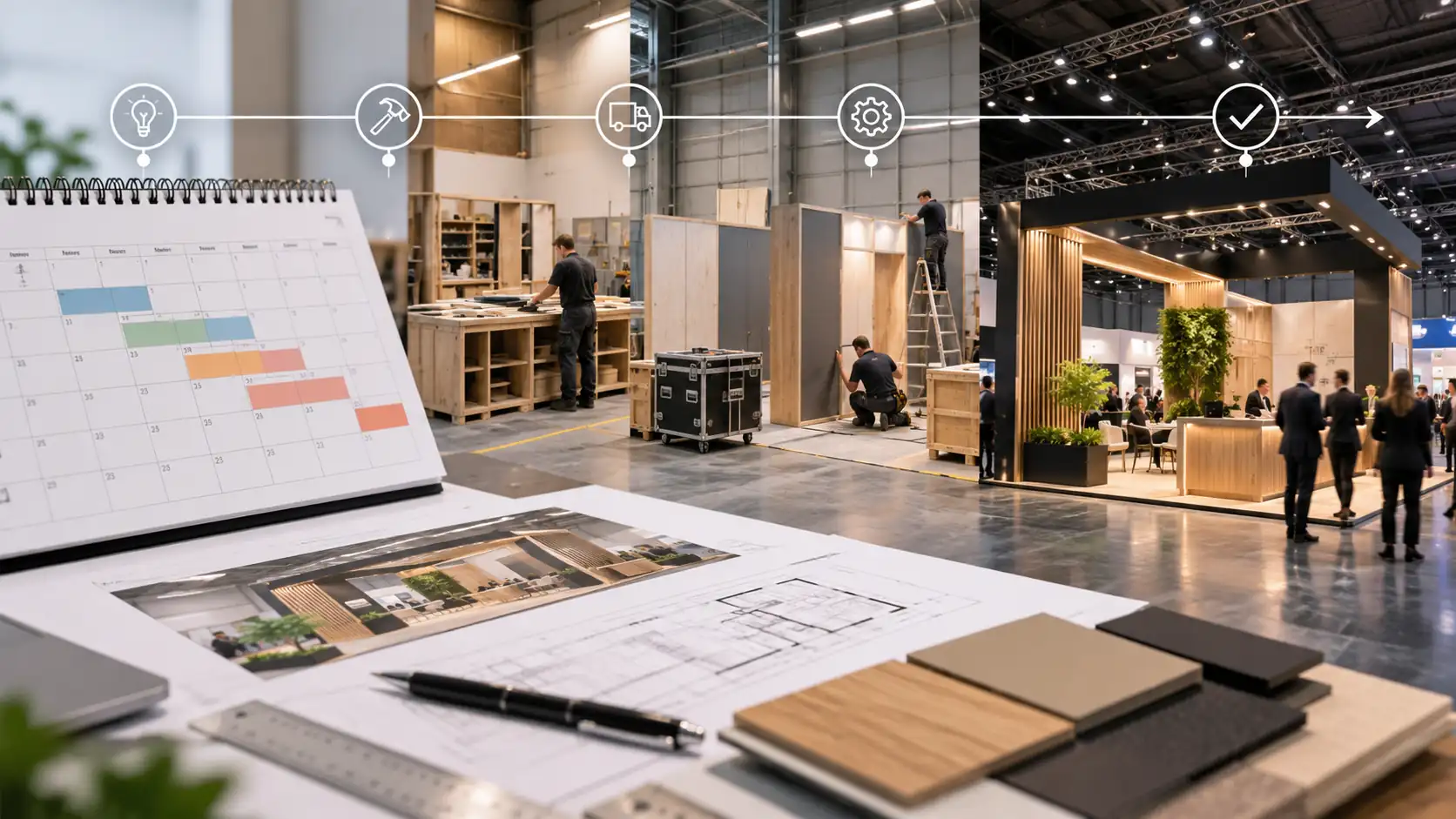
How much time does it take to prepare a trade show booth? As a planning reference, a custom project of medium complexity may require between 10 and 14 weeks from briefing to installation.
Complex projects may require 14-20 weeks or more. A simple modular booth may be completed with less lead time. These ranges are planning references, not universal deadlines.
Trade show booth fabrication lead times for international events depend on design, engineering, materials, permits, graphics, transportation, installation, and available production capacity.
The key is to plan backward from the trade show opening date and control which tasks block the ones that follow.
What determines the fabrication timeline for a trade show booth
Total booth project lead time: the period between the start of the project and the handover of a completed, tested space that is ready for opening.
Fabrication time: the period specifically dedicated to producing structures, furniture, graphics, and other physical components.
These two concepts are different. A booth may require five weeks of workshop production but twelve weeks overall because design, engineering, approvals, and purchasing come first.
Backward scheduling: planning method that uses the trade show opening date as the final milestone and works backward to determine installation, transportation, fabrication, engineering, and briefing dates.
Critical path: sequence of tasks whose delay can directly push back the project completion date.
Dependency: a relationship in which one task cannot be completed correctly until another decision or activity has been finished.
Contingency buffer: time reserved to absorb issues without automatically affecting final delivery.
A realistic schedule should control at least five variables:
- Scope: what must be designed, fabricated, rented, and installed.
- Complexity: special structures, audiovisual systems, machinery, rigging, or finishes.
- Approvals: decisions pending from the agency, client, organizer, or venue.
- Capacity: actual availability of workshop resources, suppliers, printing, and crews.
- Logistics: distance, transportation, access, and installation windows.
These variables are connected. A structural change may affect drawings, component breakdowns, graphics, transportation, and installation sequence.
Recommended timeline from briefing to the trade show
12-16 weeks before: briefing, objectives, and scope
Trade show booth briefing: a document that converts the exhibitor’s objectives into functional, visual, technical, and budget requirements.
It should define what the space needs to accomplish before design begins.
- Trade show, city, and dates.
- Floor plan and contracted booth space.
- Number of open sides.
- Business objectives.
- Products to be displayed.
- Meeting areas.
- Storage and hospitality.
- Audiovisual systems.
- Graphics and branding.
- Budget.
Risk elements should also be identified early, including double-deck structures, large heights, ceilings, suspended structures, heavy machinery, or special installations.
Exit milestone: the briefing is sufficiently defined to begin design without depending on structural decisions that are still unknown.
10-14 weeks before: design and technical engineering
Trade show booth engineering: the process of converting a creative concept into drawings, dimensions, materials, connections, and installations that can be fabricated and assembled.
At this stage, the design is validated against the booth space, venue requirements, and construction sequence.
- Heights and dimensions.
- Structural stability.
- Materials and finishes.
- Electricity and lighting.
- Screens and audiovisual systems.
- Accessibility.
- Rigging.
- Product or machinery access.
Technical validation: verification that the design can be fabricated and installed in accordance with applicable requirements.
Permits should be incorporated into the same timeline. They are not an administrative task separate from fabrication.
Messe Frankfurt, for example, currently requires documentation for certain structures subject to approval to be submitted no later than six weeks before installation begins.
The venue also states that some events may apply their own specific technical guidelines.
8-12 weeks before: technical freeze and critical purchasing
Critical purchase: a purchase whose delay can block production, testing, or installation and affect the critical path.
Purchasing decisions should not be prioritized solely by cost. A low-cost component can still block an entire structure.
- Special hardware.
- Imported components.
- Specific lighting.
- Screens.
- Interactive systems.
- Custom furniture.
- Materials with limited availability.
The technical team should identify a final decision date for each critical element.
Technical freeze date: the point after which significant changes must be treated as modifications with potential impact on schedule and cost.
A technical freeze does not mean that all changes are prohibited. It means their consequences should be evaluated before approval.
5-9 weeks before: booth production
Trade show booth production: transformation of technical documentation into structures, furniture, finishes, and components prepared for transportation and installation.
Carpentry, machining, painting, metalwork, lighting, furniture production, and integration work may all take place simultaneously during this phase.
All teams must work from the same approved version.
- Current drawings.
- Identified component breakdowns.
- Dimensional control.
- Material tracking.
- Finish quality control.
- Component inventory.
- Change log.
Version control: the procedure used to identify which drawing or file is valid and prevent fabrication from outdated documentation.
This is especially important when the agency, technical team, print department, and workshop are working at the same time.
ERP-CAD/CAM systems can help connect management, technical documentation, and production. Full-Expo currently states that it integrates these types of systems into its processes.
3-6 weeks before: graphics, testing, and preassembly
Final artwork: approved graphic file technically prepared for production on the final substrate.
Graphics require stable dimensions. Printing before measurements are finalized increases the risk that an element will no longer fit correctly.
- Final dimensions.
- Resolution.
- Scale.
- Color.
- Substrate.
- Panel breakdown.
- Installation system.
Preassembly: advance assembly of critical components to verify dimensions, connections, finishes, or functionality before they are shipped to the trade show.
It is not always necessary to assemble the entire booth in the workshop.
Priority should be given to components whose failure would be difficult, expensive, or time-consuming to resolve inside the exhibit hall.
- Special structures.
- Dimensional signage.
- Lightboxes.
- Custom furniture.
- Integrated lighting.
- Audiovisual supports.
Functional test: verification that a component performs its intended function correctly before shipment.
1-3 weeks before: shipping and final logistics
Shipping preparation: preparation of fabricated materials for packing, inventory, loading, and transportation to the venue.
Logistics planning starts earlier, but this is the phase in which the final shipment is confirmed.
- Final weight.
- Volume.
- Number of packages.
- Vehicles.
- Route.
- Access schedules.
- Unloading equipment.
- Credentials.
Installation window: the period authorized by the trade show for booth installation before opening.
For an international event, distance, driving times, logistics restrictions, public holidays, and venue procedures must all be considered.
The loading order should follow the installation sequence. Components needed first should remain accessible during unloading.
Final days before opening: installation, testing, and handover
Layout setting: transferring the dimensions and positions defined in the project drawings to the actual booth space.
Before construction begins, the booth space, dimensions, columns, utility connections, and obstacles should be checked.
Any discrepancy between the drawings and actual conditions should be evaluated before an improvised modification is made.
Installation usually follows a sequence of dependencies:
- Unloading and inspection.
- Layout setting.
- Flooring and structures.
- Electricity and technical installations.
- Finishes.
- Graphics and signage.
- Audiovisual systems.
- Furniture and products.
- Cleaning.
- Final testing.
Final quality control: technical, visual, and functional review carried out before the booth is handed over to the exhibitor.
The final hours should be reserved for verification, not for continuing to fabricate unfinished components.
- Structure and finishes.
- Lighting.
- Electricity.
- Screens and content.
- Graphics.
- Furniture.
- Doors and storage areas.
- Cleaning.
What extends booth production lead times
The timeline increases as the number of dependencies, approvals, and custom elements grows.
Not all factors affect the schedule in the same way.
- Double-deck structures: add engineering, documentation, and structural fabrication.
- Rigging: adds coordination with suspension points and the venue.
- Machinery: affects access, loads, and installation sequence.
- Audiovisual systems: add supports, electricity, signal, and testing.
- Custom furniture: increases workshop operations.
- Special materials: may involve longer procurement lead times.
- International projects: add transportation and destination-specific requirements.
Technical complexity: the number and interdependence of elements that require specific design, fabrication, integration, or validation.
Booth size alone does not determine lead time. A 40 m² booth with highly customized solutions may be more complex than a 100 m² booth built with repetitive modular systems.
Which changes create the greatest risk of delay
Late change: a modification made after the planned decision milestone that requires downstream work to be reviewed.
Changes are not necessarily negative. The risk depends on when they happen and which dependencies they affect.
- Changing dimensions after component breakdowns have been created.
- Changing graphics after printing has started.
- Adding screens after electrical planning has been finalized.
- Increasing height after the structure has been validated.
- Changing furniture after packing has been finalized.
- Adding heavy products after logistics have been defined.
A change should answer four questions: what is changing, which tasks are affected, what cost does it create, and how much schedule does it consume?
Rework: repetition or modification of work already completed because of a change, error, or incompatibility.
Reducing rework is one of the most direct ways to protect both the schedule and the budget.
Internal deadlines vs. external deadlines: the key difference
An agency can control the briefing and the internal approval schedule. It cannot fully control deadlines imposed by organizers, venues, or official service providers.
Internal milestone: a project date controlled mainly by the agency, client, or manufacturer.
External milestone: a date established by a third party that may affect booth execution.
- Internal: briefing, design approval, final artwork, production, and testing.
- External: permits, rigging, technical services, credentials, and access schedules.
External milestones should be placed into the schedule first. Internal work should then be organized around them.
Messe Frankfurt provides a clear example: certain structures must submit drawings no later than six weeks before installation begins and cannot start construction without the corresponding approval.
The same source states that special constructions, double-deck booths, outdoor structures, stages, and certain platforms require specific approval.
This demonstrates that a trade show’s critical deadline may occur weeks before installation begins.
How to plan to reduce rush costs and last-minute work
Schedule compression: reduction of available project time by overlapping tasks, removing buffers, or accelerating work.
Compressing a schedule does not automatically make a project unfeasible. It changes its risk profile.
The more engineering, purchasing, fabrication, and graphics overlap, the greater the risk that a change will require work to be repeated.
To reduce last-minute pressure:
- Finalize structural requirements early.
- Separate critical decisions from decorative decisions.
- Identify long-lead purchases.
- Track permits from the engineering phase.
- Set a deadline for final artwork.
- Work from one controlled document version.
- Reserve time for testing.
- Plan transportation with sufficient buffer.
Rush cost: additional cost caused by accelerating production, transportation, procurement, or installation compared with the planned process.
There is not always an explicit surcharge. The additional cost may also appear through overtime, special transportation, remanufactured components, or loss of alternative options.
For this reason, workshop time alone does not provide an accurate assessment of an expedited project.
Which KPIs can be used to monitor a booth schedule
Timelines can also be measured. Historical data makes it possible to identify where recurring delays occur.
- Milestones met: percentage of internal deliverables completed on schedule.
- Late changes: modifications made after technical freeze.
- Rework: components or tasks that had to be repeated.
- Overtime: additional labor generated by schedule compression.
- Rush purchases: components purchased outside the planned timeline.
- Installation incidents: issues detected at the venue.
- Handover buffer: time between booth completion and event opening.
Schedule variance: the difference between the planned completion date of a task and its actual completion date.
Measuring this variance helps identify whether the problem is related to approvals, purchasing, fabrication, graphics, or logistics.
The most important indicator is not simply finishing on time at any cost. It is finishing on time while maintaining control over quality, budget, and safety.
How Full-Expo can coordinate timelines for an international trade show
Full-Expo works exclusively with agencies and B2B professionals and offers trade show booth fabrication, production, and installation services without selling directly to end clients.
The company also states that it integrates an ERP-CAD/CAM system to connect management and production and improve accuracy and consistency between phases.
For an agency, the value of a technical partner lies in reducing interfaces between the technical team, workshop, graphics, logistics, and installation.
That does not mean that every deadline is achievable.
A responsible partner should be able to identify which timeline is realistic, which phases can overlap, and what risks appear when the available buffer is reduced.
The process therefore returns to the same pattern:
- Define: scope and objectives.
- Validate: engineering and permits.
- Produce: materials and components.
- Verify: graphics, finishes, and testing.
- Transport: shipping and access.
- Install: sequence and technical systems.
- Hand over: final quality control before opening.
A realistic schedule is not about having the maximum number of weeks available. It is about making every critical decision before it blocks the next phase.
For international trade shows, good planning means reserving time not only to fabricate, but also to approve, verify, transport, and test.
Frequently asked questions about trade show booth fabrication lead times (FAQs)
There is no single timeline. As a planning reference, a medium-complexity custom project may benefit from 10-14 weeks from briefing to installation.
It is advisable to begin several months in advance when the project includes special structures, permits, audiovisual systems, machinery, custom materials, or international logistics.
Fabrication time refers specifically to production work. Total project lead time also includes briefing, design, engineering, permits, graphics, transportation, and installation.
It is the sequence of tasks whose delay can directly affect delivery because there is not enough buffer before the next phase.
They should be finalized once dimensions are stable and there is enough time to review files, print, perform quality control, and correct potential issues.
The impact on drawings, components, materials, graphics, logistics, and installation should be analyzed before the change is approved.
They can be reduced by finalizing critical decisions early, identifying permits and special purchases, controlling versions, and maintaining sufficient time for testing and transportation.
Yes. A structure subject to approval may introduce a deadline that occurs before installation and determine when the technical project must be finalized or can move into execution.
It may be possible for certain projects, but it depends on complexity, available capacity, materials, approvals, and logistics. Reducing lead time usually reduces the available buffer as well.
It should include briefing, design, engineering, permits, purchasing, fabrication, graphics, testing, shipping, installation, handover, and contingency buffers.