
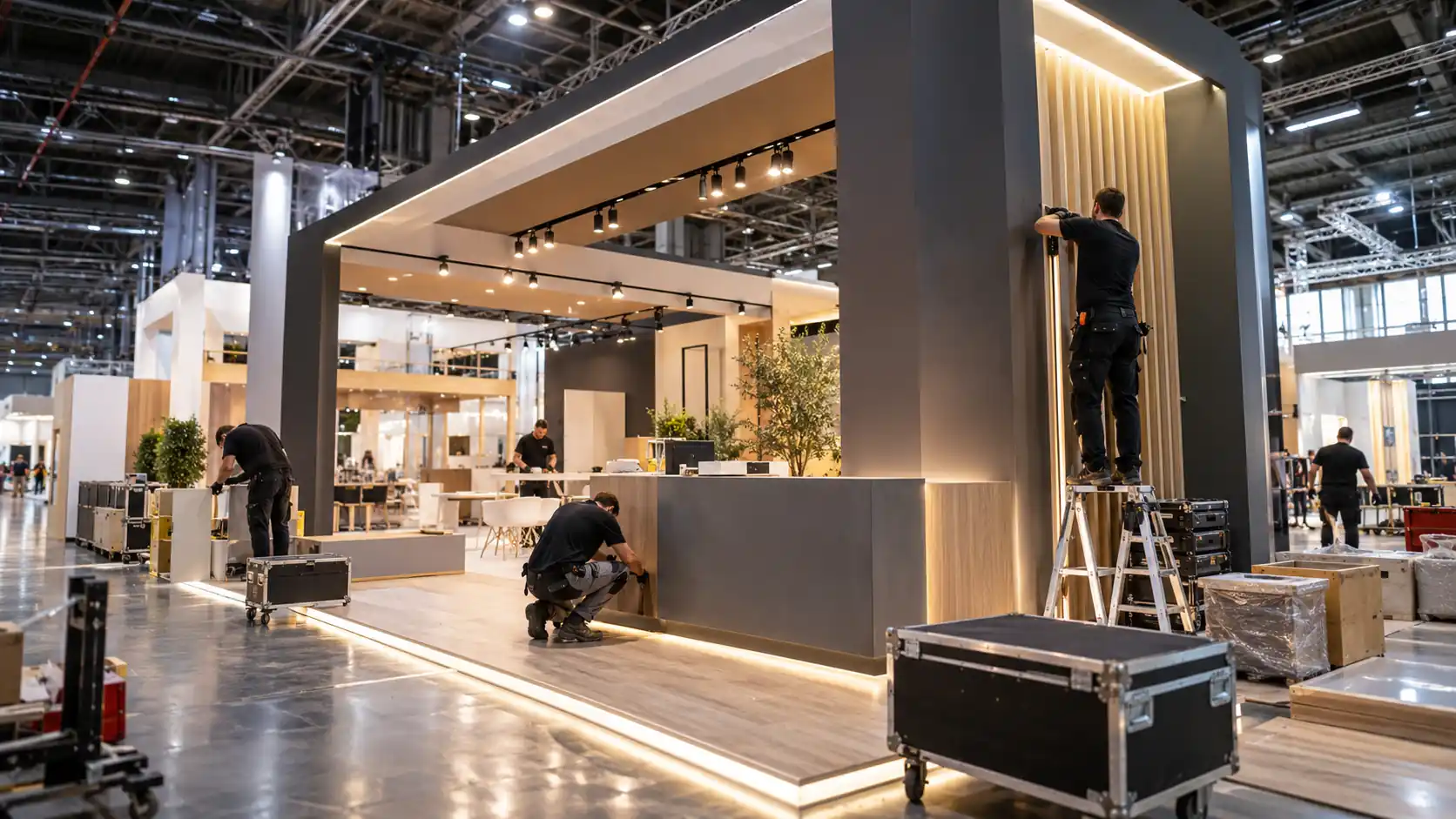
What a full-service booth solution for IFEMA Madrid should include
A booth for IFEMA MADRID does not begin inside the exhibit hall. Installation is only the final visible phase of a process that connects design, engineering, fabrication, transportation, regulations, technical services, and quality control.
For an agency, managing each phase through separate suppliers multiplies the number of interfaces. A single change can simultaneously affect the workshop, graphics, electrical systems, logistics, and installation.
Full-service booth solution: an execution model that coordinates technical development, fabrication, logistics, installation, and final quality control through a shared project workflow.
B2B technical partner: an industrial supplier that works for agencies and industry professionals, providing execution capacity without replacing the agency’s creative direction or commercial relationship with the end client.
For trade show booth fabrication and installation at IFEMA Madrid for agencies, the process can be summarized in six phases: validate, develop, fabricate, transport, install, and verify.
All six phases are interdependent. A design decision affects production; production determines transportation requirements; and logistics must comply with the event’s rules and schedules.
IFEMA MADRID has mandatory general regulations for exhibitors and contracted or subcontracted companies. In addition, each trade show may publish specific requirements in its exhibitor guide.
This means that a project previously used at IFEMA should not automatically be considered approved for another event. Documentation and requirements must be reviewed for the specific edition.
- General regulations: establish the common conditions for participation and work at the venue.
- Exhibitor guide: specifies dates, schedules, requirements, and procedures for the event.
- Booth project: defines dimensions, structure, technical installations, graphics, and equipment.
- Execution plan: connects responsibilities, production, transportation, installation, and handover.
Custom-designed booth: an exhibit space developed through a customized construction project rather than relying exclusively on a standard modular solution offered by the organizer.
At certain IFEMA events, custom-designed booths must submit their project for prior approval and pay the corresponding installation rights or fees.
Dates and conditions are not universal. They must always be taken from the documentation specific to each event.
How to manage fabrication, logistics, and installation through a single B2B workflow
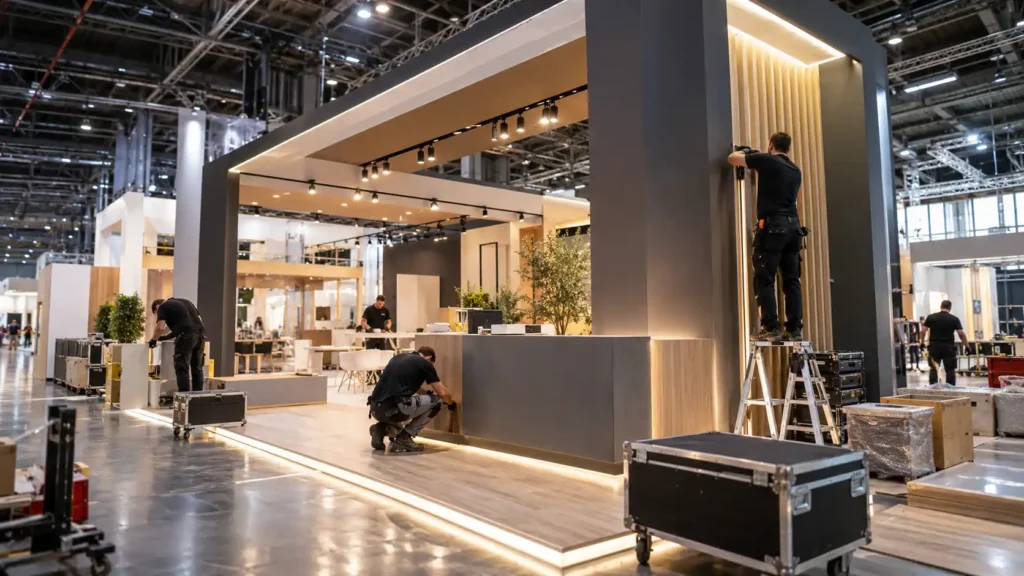
1. Technical validation before production. The first step is to verify that the design can be built within the assigned booth space and under the applicable conditions.
The review should cover square footage, open sides, height, shared walls, enclosures, suspended elements, electricity, audiovisual systems, machinery, access, and any special installations.
The validation process should also determine which documentation requires prior approval and who will be responsible for submitting it.
A simple way to control this phase is to work with five fields: requirement, responsible party, documentation, deadline, and status.
- Requirement: what must be complied with or ordered.
- Responsible party: agency, manufacturer, exhibitor, or technical provider.
- Documentation: required drawings, certificates, or applications.
- Deadline: the final operational date for completing the process.
- Status: pending, submitted, approved, or completed.
This method helps prevent the fabrication of an element that later needs to be modified in order to obtain approval.
2. Engineering and production development. A rendering communicates the visual intent, but it does not necessarily explain how each component should be built.
The manufacturer must convert the design into drawings, component breakdowns, specifications, and connection systems that can be fabricated, packed, and installed.
Technical development of a booth: the transformation of a creative design into execution documentation defining materials, dimensions, connections, technical installations, and construction sequence.
This phase also connects graphics, lighting, and audiovisual systems with the structure. A screen requires support, cabling, and power; a lightbox requires dimensions and depth that are compatible with the wall.
The agency retains creative control while the manufacturer provides technical input on feasibility, production, and installation.
3. Fabrication and version control. Once the project has been validated, physical production begins.
Carpentry, painting, structures, furniture, printing, and other components must all work from the same technical version.
- Use clearly identified and current drawings.
- Verify critical dimensions.
- Record modifications.
- Control materials and finishes.
- Test special elements when necessary.
- Prepare an inventory for transportation.
The purpose of version control is to prevent the workshop, graphics team, and installation crew from following different instructions after a change.
Preassembly can be useful for complex elements. It allows dimensions, connections, or functionality to be checked before the material leaves for Madrid.
4. Logistics from production to IFEMA. Transportation does not end when the vehicle arrives at the venue.
Installation logistics: planning of packing, loading, transportation, access, unloading, internal handling, packaging management, and the subsequent return of the booth.
IFEMA establishes its own rules for vehicle access and parking during installation and dismantling. Specific days, schedules, and gates depend on each event.
For this reason, shipping must be planned around the event-specific schedule.
- Packing: protect and identify every component.
- Loading: organize materials according to the installation sequence.
- Transportation: calculate departure time and operating margin.
- Access: verify current schedules, gates, and conditions.
- Unloading: plan the machinery and handling equipment required.
- Return: plan dismantling, sorting, and reloading afterward.
A load organized exclusively to maximize vehicle capacity can make installation more difficult. The components needed first should remain accessible when the vehicle is opened.
5. Installation and technical coordination at IFEMA. Before construction begins, the booth space should be physically inspected.
Actual dimensions, columns, utility connections, and obstacles should be compared with the documentation used during production. Any significant discrepancy should be resolved before work continues.
Installation can be sequenced from layout and structural construction through electricity, graphics, furniture, products, and final testing.
Several recent IFEMA event guides require the use of protective helmets, high-visibility vests, and safety footwear in exhibition areas during installation and dismantling.
Waste management is also part of execution. IFEMA guides assign companies participating in installation and dismantling direct responsibility for the waste they generate.
The specific procedures should always be reconfirmed for each event.
Installation may also involve services that depend on the venue or authorized providers. Electricity, rigging, connectivity, certain logistics services, or security may require specific contracting or authorization.
The manufacturer should identify these interfaces, but coordination should not be confused with authorization. Preparing or managing an application does not mean having the authority to approve it.
6. Quality control and handover. The project does not end when the tools are removed.
Booth quality control: a technical, visual, and functional inspection carried out before opening to verify that the finished booth matches the project and operates correctly.
- Architecture: dimensions, stability, and finishes.
- Graphics: position, alignment, and surface condition.
- Lighting: operation and direction.
- Audiovisual systems: signal, content, and connections.
- Furniture: quantity, placement, and functionality.
- Cleaning: removal of waste and preparation for opening.
- Brand: visibility of logos and messages from the main visitor routes.
Issues should be documented. A component that required adaptation or a logistics problem can provide useful information for future projects, especially when the booth is intended to be reused.
For an agency, the quality of a B2B service should not be measured solely by the visual result.
Schedule compliance, technical accuracy, change management, finish quality, traceability, and the ability to resolve issues without losing control of the project should also be evaluated.
Full-Expo states that it works exclusively for agencies and B2B professionals on the fabrication, production, and installation of booths for European trade shows and conferences.
The company has approximately 2,000 m² of production and storage facilities in L’Hospitalet de Llobregat, with dedicated areas for carpentry, assembly, painting, and logistics.
For a project at IFEMA Madrid, the distance between the production facility and the venue must be explicitly incorporated into the logistics schedule.
The value of the model does not depend on being physically located next to IFEMA. It depends on producing with sufficient lead time, organizing transportation correctly, and coordinating access and installation within the event’s available time window.
For agencies working across several cities, using the same industrial partner can also help maintain consistent production standards, documentation, and quality control.
Regulations and logistics still need to be adapted to each venue. What can be reused is the working method: validate, develop, fabricate, transport, install, and verify.
When applied correctly, this workflow allows trade show booth fabrication and installation at IFEMA Madrid for agencies to be managed as a single technical project rather than as a succession of independent suppliers.
Frequently asked questions about booth fabrication and installation at IFEMA Madrid (FAQs)
It depends on the event and the project. Some trade shows require advance submission of the design, technical documentation, and safety-related requirements for review or approval.
No. IFEMA has general regulations, but each event may establish specific dates, schedules, procedures, and requirements in its exhibitor guide.
A specialized company can execute the project as long as it complies with the general regulations, the event-specific conditions, and the applicable installation requirements.
Fabrication, packing, loading, route planning, access schedules, unloading, and subsequent dismantling should all be coordinated according to the event calendar and venue conditions.
It should verify the structure, finishes, graphics, lighting, audiovisual systems, furniture, cleanliness, and overall functionality against the approved project.
It can integrate technical development, fabrication, logistics, installation, and quality control while the agency retains creative direction and the commercial relationship with its client.