
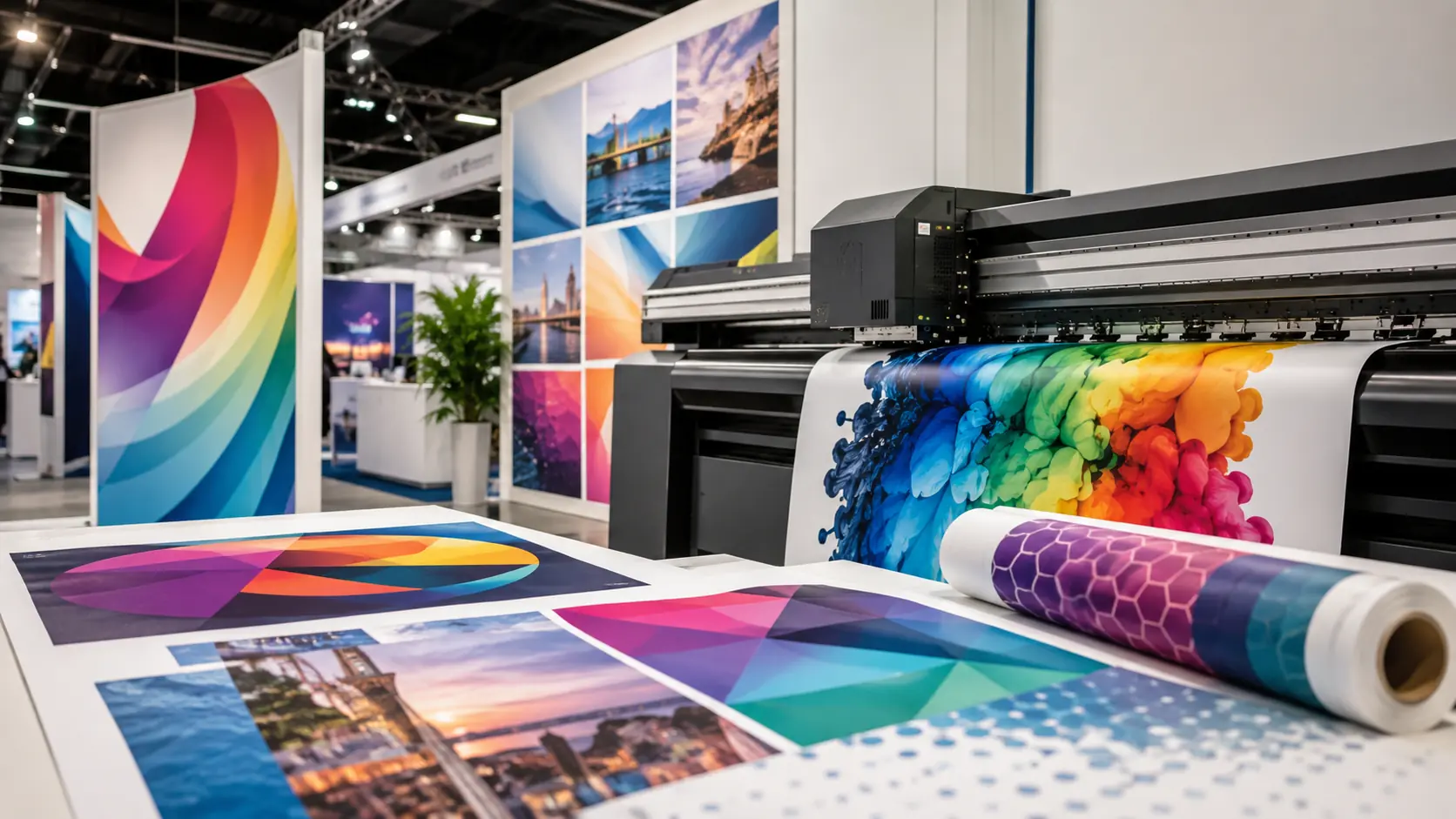
Graphics Printing as a Strategic Part of the Booth
Graphics printing is one of the factors that most strongly influences a brand’s visibility, clarity, and overall perception at a trade show. A booth may feature attractive architecture, yet still lose effectiveness if its messages are difficult to read, its colors are inconsistent, or its images lack sufficient quality.
Large-format printing transforms walls, structures, fabrics, panels, glass, floors, and backlit elements into communication surfaces. Its purpose is not simply to decorate the booth. It should identify the company, explain its value proposition, and guide visitors toward a specific action.
At a trade show or conference, every graphic surface serves a specific purpose. An overhead sign helps visitors locate the brand. A printed wall communicates key benefits. A floor graphic can direct traffic. A backlit panel highlights a product or campaign.
For this reason, the quality of a graphic solution depends on much more than print resolution. The substrate, printing technology, color management, file preparation, lighting, finish, installation, and viewing distance all play a role.
This article explains the main printing options for trade shows and conferences and provides a method for selecting the most appropriate solution for each project.
What Is Large-Format Printing?
Large-format printing (definition): the digital production of oversized graphics on flexible or rigid materials for visual communication, advertising, decoration, signage, or exhibit applications.
In the trade show industry, it is commonly used to produce:
- Wall graphics: images and messaging for booth walls.
- Adhesive vinyl graphics: customization of panels, glass, furniture, and floors.
- Fabric graphics: tensioned backdrops, lightboxes, banners, and wall coverings.
- Rigid panels: signage, photography, product information, and decorative displays.
- Backlit graphics: graphics designed to be illuminated from behind.
- Banners and flexible media: large-surface applications or suspended structures.
The term covers a broad category. There is no single printing technology or material that is suitable for every application.
A Framework for Choosing a Trade Show Printing Solution
The selection process should be based on seven related criteria:
- Objective: identify, inform, guide, attract, or convert.
- Viewing distance: how close visitors will be when reading the graphic.
- Surface: the material, texture, shape, and condition of the substrate.
- Duration: one-time use, temporary campaign, or multi-event schedule.
- Lighting: front lighting, ambient lighting, side lighting, or backlighting.
- Installation: application method, removal, and potential reuse.
- Logistics: volume, weight, packaging, transportation, and storage.
These criteria should be evaluated as a system. A material may deliver excellent image quality but still be unsuitable if it is too heavy, incompatible with the planned installation method, or difficult to reuse.
Main Graphics Printing Options for Trade Shows
Printed Adhesive Vinyl
Printed vinyl is a versatile solution for customizing smooth surfaces. It can be applied to walls, panels, counters, doors, glass, and other booth elements.
Main advantages:
- High level of customization.
- Strong reproduction of images and colors.
- Adaptability to components of different sizes.
- Efficient production for temporary campaigns.
- Option to add protective laminates.
Choosing the right adhesive is just as important as the printing itself. Removable vinyl may be suitable for a temporary installation, while a longer-term application may require a different adhesive system.
The surface type, cleanliness, installation temperature, and the presence of seams, curves, or irregularities must also be considered.
Large-Format Fabric Graphics
Fabric printing is commonly used for tensioned walls, backdrops, lightboxes, modular frames, hanging banners, and large-surface coverings.
Advantages of fabric graphics:
- Lower weight than many rigid substrates.
- Easy folding, packaging, and transportation.
- Seamless visual appearance.
- Reduced glare on certain fabrics.
- Ability to replace graphics while retaining the structure.
Dye-sublimation printing is especially common for polyester fabrics. The dye is fixed using heat, so the fabric, ink, and process must be correctly matched.
For tensioned systems, finishing is critical. Dimensions, edge type, and fabric elasticity must be compatible with the frame to prevent wrinkles, distortion, or insufficient tension.
Direct Printing on Rigid Panels
Direct printing applies the image directly onto a rigid material without the need to add printed vinyl afterward.
Depending on the project and production equipment, it may be used on materials such as:
- Expanded PVC.
- Acrylic.
- Composite panels.
- Technical board.
- Prepared wood panels.
- Cellular or lightweight materials.
UV printing is one of the technologies used for these applications. The inks are cured with ultraviolet light during production and can be applied to a range of rigid materials.
This option works well for signage, product imagery, decorative elements, informational panels, and components that need to retain a stable shape.
Backlit Printing
Backlit graphics are designed to work with a light source positioned behind the material. They are used in lightboxes, illuminated fabric frames, and promotional panels.
Their primary advantage is the ability to stand out in visually competitive environments.
Production must account for:
- Color density: light can change the perceived intensity of tones and contrasts.
- Uniformity: illumination should be evenly distributed without dark areas or overly bright spots.
- Opacity: the material must control light transmission correctly.
- Resolution: it should match the intended viewing distance.
- Finishing: seams and tension points should remain as unobtrusive as possible.
A graphic that looks correct without lighting may perform differently once installed in a lightbox. For that reason, testing should be conducted under conditions similar to actual use.
Floor Vinyl and Floor Graphics
Floor graphics can guide traffic, highlight zones, identify products, or direct visitors toward a demonstration.
They should not be produced using just any vinyl. The complete system must account for the substrate, adhesive, finish, and traffic conditions.
Relevant factors include:
- Expected duration.
- Traffic level.
- Flooring type.
- Cleaning conditions.
- Abrasion resistance.
- Required slip-resistance properties.
- Removal procedure.
The organizer may require specific documentation for materials installed in walkable areas. The event’s technical manual should therefore be reviewed before production begins.
Transparent and Perforated Vinyl
Transparent materials make it possible to work on glass, partitions, and acrylic surfaces while preserving full or partial transparency.
Common applications include:
- Logos and messaging on glass.
- Translucent effects.
- Partial privacy for meeting rooms.
- Decoration of enclosures.
- Communication intended to be visible from one specific side.
A white underbase may be required when strong color intensity must be maintained on a transparent material. Without it, some colors may lose saturation or shift depending on the background.
Banners, Mesh, and Flexible Media
Banners are used for large surfaces, backdrops, enclosures, portals, and selected suspended elements.
Mesh materials allow partial airflow and may be useful where the wind resistance of a solid banner would create problems.
For indoor use, the selected material must comply with venue requirements related to fire performance, finishing, anchoring, and technical documentation.
Printing Technologies Used in Large Format
The printing technology should be selected according to the material, application, finish, and required performance.
Water-Based or Latex Printing
These technologies are used in a range of visual communication applications, including vinyl, paper, prepared fabrics, and wall coverings.
Their suitability depends on the equipment, ink, substrate, and conditions of use. It should not be assumed that a specific technology will perform the same way on every material.
UV Printing
UV printing can be used on both flexible and rigid substrates. The ink cures during the production process, allowing the printed material to be handled relatively quickly.
Some systems also support white ink, which is useful for transparent materials, colored substrates, and layered graphic effects.
Dye-Sublimation Printing
Dye sublimation is used primarily for polyester fabric graphics. It may involve printing onto transfer paper followed by heat transfer, or direct processes compatible with the fabric.
The result depends on file preparation, temperature, pressure, fixation time, and material composition.
Solvent and Eco-Solvent Printing
These technologies are used primarily for flexible media, especially vinyl and certain signage materials.
The selection process should consider durability, drying time, lamination, ventilation during production, and substrate compatibility.
How to Choose Between Vinyl, Fabric, and Rigid Panels
The comparison should be based on the application rather than price alone.
Printed Vinyl
- Best for: temporary customization of smooth surfaces.
- Strength: versatility and adaptability.
- Consideration: surface preparation and removal.
Fabric Graphics
- Best for: large backdrops, frames, and reusable systems.
- Strength: lightweight logistics and interchangeable graphics.
- Consideration: finishing, tension, and color matching.
Rigid Panels
- Best for: signage, products, photography, and stable display elements.
- Strength: flatness and structural stability.
- Consideration: weight, volume, and protection during transportation.
For many booths, the most effective solution is a combination of all three. The structure may use fabric graphics on main walls, vinyl on furniture, and rigid panels for signage or product displays.
Color Management in Large-Format Printing
The same color can look different when printed on different materials. Fabric, matte vinyl, rigid panels, and backlit media reflect or transmit light in different ways.
Color management (definition): the set of processes used to convert and control color across devices, files, printers, inks, and materials.
ICC profiles describe how a device or printing condition reproduces color. They help create more controlled conversions between color spaces.
To improve consistency:
- Define verifiable corporate color references.
- Use profiles suited to each printer, ink, and substrate combination.
- Calibrate production equipment.
- Avoid judging color only on an uncalibrated monitor.
- Produce physical proofs on the final material.
- Evaluate samples under representative lighting.
- Compare materials when multiple technologies must be used together.
It is not always possible to reproduce a corporate color identically across every material. The professional goal is to control the variation, anticipate it, and create a consistent appearance throughout the booth.
File Preparation for Large-Format Printing
A file that looks correct on screen may present problems once enlarged. Prepress should verify both graphic and technical requirements.
Scale and Dimensions
The file should clearly indicate whether it has been prepared at full size or at a defined scale. Confusing scale with resolution can result in pixelated graphics or incorrectly sized elements.
Image Resolution
There is no single resolution value that works for every project. The requirement depends on viewing distance, final size, material, and image type.
A photograph viewed at close range needs more detail than an overhead graphic seen from across the exhibition hall.
Logos and Text
Logos, icons, and typography should retain sharp edges. Whenever possible, these elements should be supplied as vector graphics.
Bleed and Safe Area
Bleed compensates for small variations in cutting or finishing. The safe area prevents text and logos from sitting too close to edges, seams, joints, or framing systems.
Files and Fonts
Before final artwork is submitted, fonts, transparencies, linked images, and overprint settings should be reviewed. The production provider should confirm the required file format and workflow specifications.
The Role of Viewing Distance
Large-format graphics should be designed for a real physical environment, not only for inspection on a monitor.
Viewing distance affects:
- Text size.
- Amount of information.
- Required resolution.
- Contrast.
- Line weight.
- Level of image detail.
A practical hierarchy can be organized into three levels:
- Long distance: brand, category, and main message.
- Medium distance: benefits, products, or applications.
- Close range: specifications, case studies, QR codes, and details.
Trying to include close-range information in a graphic designed for long-distance viewing reduces clarity.
Finishes That Improve Quality and Durability
Printing can be enhanced with different treatments and finishing systems.
- Lamination: adds protection and changes the surface finish.
- Matte finish: can reduce glare under certain conditions.
- Gloss finish: increases apparent contrast, although it may reflect more light.
- Contour cutting: produces custom shapes, logos, and special elements.
- Routing: cuts rigid panels into specific forms and dimensions.
- Grommets and reinforcements: support banner and mesh installation.
- Fabric finishing: adds silicone edging, hook-and-loop tape, pole pockets, or seams depending on the system.
- White ink: supports printing on transparent or colored materials.
The finish should be defined at the beginning. Adding it after artwork has been finalized may affect dimensions, bleed, or color expectations.
Professional Installation of Trade Show Graphics
High-quality printing can lose value if it is installed poorly. Installation should be coordinated with booth construction, electrical work, lighting, and cleaning.
Installation Checklist
- Confirm that surfaces are clean, dry, and stable.
- Verify dimensions and references before removing protective layers.
- Organize components according to the installation sequence.
- Avoid visible seams in high-attention areas.
- Check the alignment of text and images.
- Review tension in fabric graphics.
- Protect finished surfaces during the remainder of the build.
- Evaluate the final result with the finished lighting turned on.
For international projects, identifying every component is especially important. Graphics should arrive labeled by area, position, and orientation.
Reusable Graphics Printing and Sustainability
A graphic solution should not be considered sustainable based only on the material used. Its durability, transportation, reuse, and end-of-life destination must also be assessed.
Useful strategies include:
- Use graphic formats compatible with reusable structures.
- Separate temporary messaging from permanent corporate elements.
- Replace only the pieces that have become obsolete.
- Protect and store reusable graphics correctly.
- Optimize panel layouts to reduce waste.
- Track materials, dimensions, and number of uses.
- Avoid environmental claims that cannot be verified.
Fabric graphics may improve logistics because of their low weight and ability to fold, but their actual sustainability depends on the number of uses, material composition, transportation, and end-of-life treatment.
A Graphics Production Method for Trade Shows
- Step 1: define the objective of each surface.
- Step 2: measure substrates and review drawings.
- Step 3: select the material, technology, and finish.
- Step 4: adapt the design to viewing distance, lighting, and format.
- Step 5: prepare and verify the final files.
- Step 6: produce color and material proofs when necessary.
- Step 7: print, cut, finish, and label.
- Step 8: inspect every component before packaging.
- Step 9: install according to a coordinated sequence.
- Step 10: review the result under the booth’s final conditions.
Common Mistakes in Graphics Printing for Events
- Choosing material based only on price: may create installation or durability problems.
- Ignoring lighting: affects contrast, color, and readability.
- Using low-resolution images: causes loss of detail when enlarged.
- Relying only on the monitor: does not accurately predict the result on each material.
- Failing to include bleed: increases the risk of unwanted edges.
- Ignoring frames and joints: may cut through important design elements.
- Using too much text: reduces comprehension from a distance.
- Skipping proofs: increases uncertainty around critical colors.
- Producing without labels: slows installation.
- Failing to plan removal: can damage surfaces or increase dismantling costs.
How Full-Expo Integrates Large-Format Printing into the Booth
Full-Expo can coordinate graphics printing as part of the complete booth project, connecting design, production, signage, and installation.
Solutions may include:
- Printed vinyl: for walls, furniture, glass, and promotional surfaces.
- Large-format fabric printing: for backdrops, frames, lightboxes, and modular structures.
- Rigid panels: for signage, products, images, and decoration.
- Backlit graphics: for priority visual elements.
- Corporate signage: integration with dimensional lettering, illuminated signs, and wayfinding.
- Custom production: adapting each component to the booth architecture.
- Professional installation: coordination with the booth installation team.
- International project management: preparation for trade shows and conferences across Europe.
The advantage of integrating graphics with booth manufacturing is that dimensions, framing systems, lighting, and finishes can be resolved in a coordinated way.
This reduces conflicts between the visual design and the physical structure while preserving the intended communication hierarchy.
Conclusion: Graphic Quality Depends on the Entire System
Large-format printing is a fundamental tool for building visibility and consistency at a trade show. However, its performance does not depend only on the printer or the ink.
An effective graphic solution connects objective, distance, substrate, technology, color, finish, installation, and logistics. If any one of these variables is ignored, perceived quality can decline.
Vinyl provides versatility. Fabric improves portability and ease of updating. Panels provide stability. Backlighting strengthens priority messages. Floor graphics help organize visitor flow.
The best solution is not always a single technology, but a coordinated combination aligned with the booth architecture and commercial objectives.
Full-Expo can help you design, produce, and install an integrated graphics system that communicates clearly and represents your brand at trade shows and conferences across Europe.
Request a quote from Full-Expo and determine which combination of vinyl, fabric, panels, and illuminated graphics can create the strongest impact at your next event.
Frequently Asked Questions About Trade Show Graphics Printing (FAQs)
The format depends on the production workflow, although print-ready PDF files are commonly used. The provider should confirm scale, profiles, bleed, fonts, and image requirements.
It depends on final size and viewing distance. Close-range graphics require more detail than elevated pieces viewed from far away.
Pricing depends on dimensions, material, technology, finish, cutting, fabrication, and installation. Quotes should be compared using the same technical specifications.
Durability depends on the type of vinyl, surface, installation, traffic, and environmental conditions. It should be selected according to the intended use.
Vinyl adheres directly to a surface. Fabric is usually installed using tension, sewing, or fastening systems and stands out for its low weight and ease of transportation.
Not always across every substrate. Color management and physical proofs help control and reduce variation.
A material designed for backlighting should be used and printed with the correct color density to preserve contrast when the light is turned on.
Yes, using technologies compatible with rigid substrates. White ink may be required to control opacity, contrast, and color appearance.
Interchangeable fabric graphics and replaceable panels often support reuse, although the best choice depends on the structure and event schedule.
They should be delivered with enough time for prepress, proofs, production, finishing, inspection, packaging, and installation. Timelines depend on volume and complexity.