
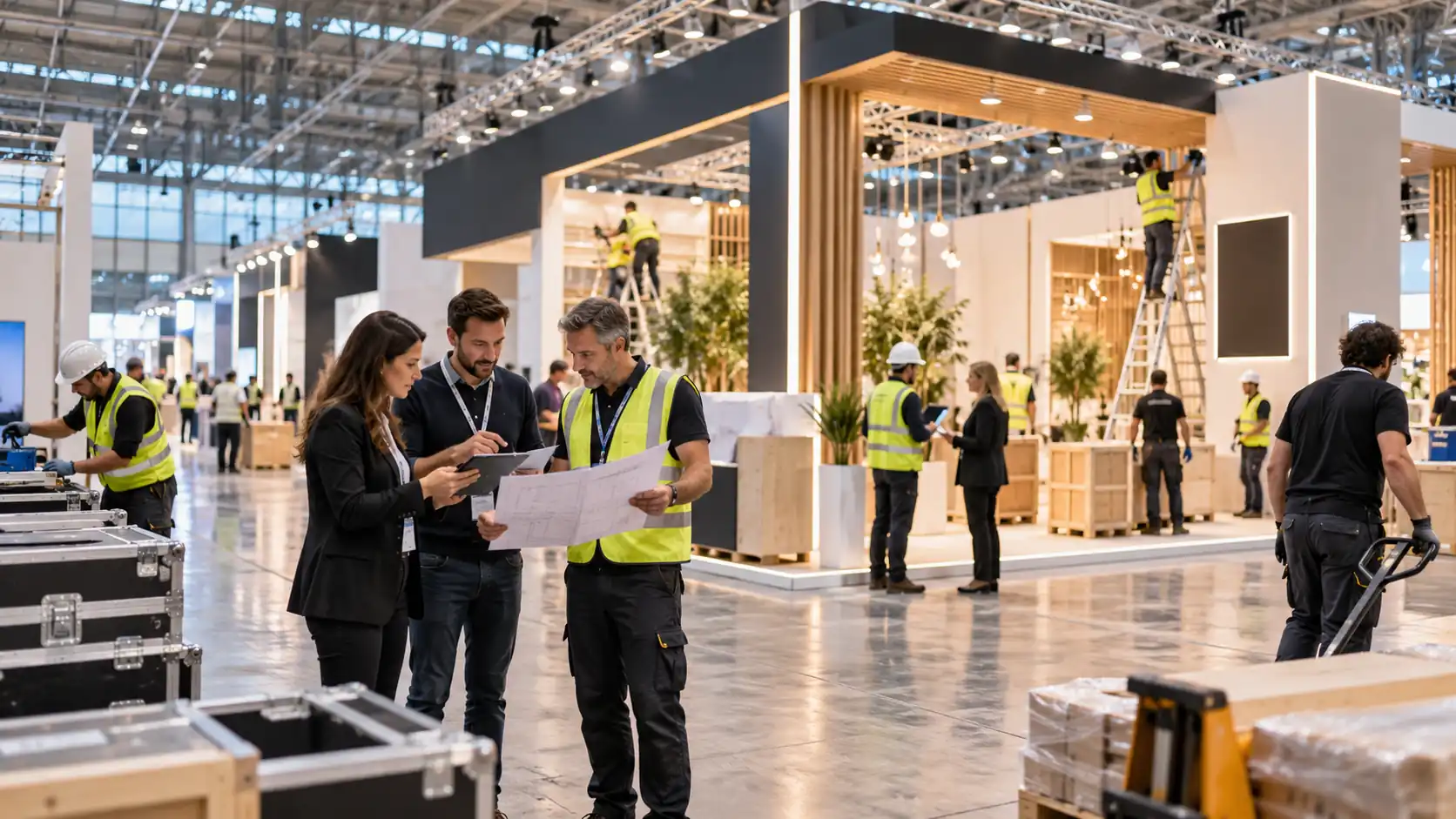
What coordinating booth installation with the venue involves
A booth can be correctly designed and fabricated yet still encounter problems upon arrival at the exhibit hall if an approval is missing, access has not been confirmed, or a technical service has not been ordered.
Permit management and venue coordination for trade show booth installation connects documentation, logistics, safety, and execution before physical work begins.
Trade show booth installation coordination: the process of aligning technical requirements, permits, personnel, vehicles, services, schedules, and responsibilities to execute an exhibit space.
Its purpose is not to guarantee that unexpected issues will never arise. Its role is to reduce foreseeable problems and establish clear responsibilities and procedures when deviations occur.
A useful operational model is based on five variables: requirement, responsible party, documentation, deadline, and status.
This framework can be applied to a structural permit, electrical connection, credential, vehicle entry, or extension of installation hours.
Documentation and permits: resolve them before production
Technical installation file: an organized set of drawings, certificates, approvals, and documents required to justify and execute the booth.
Its contents depend on the venue, event, and complexity of the project. Not every booth requires the same documentation or approval procedures.
- Drawings: floor plans, elevations, sections, and technical details.
- Structures: calculations or engineering documentation when required.
- Materials: required technical certificates.
- Electrical systems: technical memorandum, project documentation, or applicable legalization procedures.
- Safety: risk assessments and occupational documentation.
- Insurance: policies or certificates when requested.
- Special permits: rigging, complex structures, machinery, or other installations.
Fira Barcelona requires additional documentation for certain complex structures. Its regulations define cases in which a qualified technical professional must be involved in the design, calculations, or certification of structural stability.
Documentation should not be prepared after fabrication. If a solution requires prior approval, the corresponding authorization must be incorporated into the technical project schedule.
Administrative deadline: the final date or time established for submitting, ordering, or confirming a requirement before the event.
These dates should be treated as project milestones. Missing them may limit available options, generate additional fees, or leave an installation pending approval.
A simple tracking system can manage every requirement through five fields: what is needed, who is responsible, what must be submitted, when it is due, and its current status.
Credentials, safety, and team coordination
Coordination continues with the people who will carry out the installation. Designers, installers, electricians, signage teams, audiovisual technicians, and transportation crews may all be working within the same booth space.
Installation credential: identification that authorizes access to the venue during installation or dismantling phases in accordance with the event’s procedures.
Fira Barcelona requires identification for personnel involved in installation and dismantling and establishes obligations related to occupational health and safety.
Coordination should verify:
- Personnel scheduled for each workday.
- Required credentials.
- Companies working simultaneously.
- Risks associated with each activity.
- Required personal protective equipment.
- Supervisory responsibilities.
It is not always efficient for every trade to work at the same time. The sequence should prevent one activity from blocking another or creating unnecessary safety risks.
Coordination between contractors becomes especially important when several companies are working on the same booth or within the same area of the exhibit hall.
The Project Manager should know who is responsible for each task and which activities depend on another task being completed first.
Access, transportation, and freight entry
Transporting the booth to the destination city does not complete the logistics process. The final stage includes check-in, venue access, unloading, material handling, storage of packaging, and subsequent removal.
Logistics window: the available or assigned period for carrying out an access, loading, unloading, or removal operation under the conditions established by the event.
Fira Barcelona defines access procedures and conditions for each event. Operational plans may specify gates, waiting areas, and dedicated routes for vehicles and freight.
Messe Frankfurt illustrates why these procedures are not universal. It currently requires advance online registration for vehicles entering during installation and dismantling periods.
After registration, vehicles go through a check-in system. Access to loading areas depends on availability and requires the authorization issued by the venue’s system.
Before shipping materials, the following should be verified:
- Vehicle: registration, license plate, and advance requirements.
- Access: gate, check-in procedure, and authorized route.
- Schedule: available entry and unloading time slot.
- Unloading: forklifts, platforms, or other required handling equipment.
- Packaging: removal and storage during the trade show.
- Dismantling: re-entry and loading procedure after the event.
The loading order of the vehicle should also match the installation sequence. Components needed first should remain accessible when the vehicle is opened.
Schedules, official services, and responsibilities
Installation takes place within a time window established by the organizer. The number of available days matters less than the actual sequence of work that can be completed within them.
Fira Barcelona establishes specific installation periods and schedules for each event and provides procedures for certain extensions or requirements outside the standard timetable.
A typical installation plan may follow this sequence:
- Arrival: access, unloading, and inspection of the booth space.
- Construction: flooring, structures, walls, and primary elements.
- Technical installations: electricity, lighting, and audiovisual systems.
- Finishes: painting, graphics, signage, and furniture.
- Products: delivery and placement of samples or machinery.
- Handover: testing, cleaning, and final inspection.
Certain services may depend on the venue or authorized providers. Electricity, water, rigging, internet, logistics, and waste management are commonly included in these categories.
The booth contractor should not automatically assume that it can provide every service directly. It must first determine who is authorized to perform the work and through which procedure.
Responsibility matrix: a record that assigns each booth requirement a responsible party, provider, deadline, and status.
This matrix helps prevent one of the most common problems: the agency, manufacturer, and venue each assuming that another party is handling the same requirement.
For example, a screen may be included in the design, but the rigging structure, electrical power, or data connection may depend on different providers.
Installation supervision and change management
Documentation and permits prepare the project for installation, but on-site supervision verifies that actual conditions match what was planned.
The first validation should take place when the booth space is received. Dimensions, columns, utility connections, obstacles, and any relevant differences from the drawings used during planning should be checked.
Three stages should be monitored during execution:
- Site acceptance: confirm that the booth space and materials allow work to begin.
- Execution: monitor sequence, installations, safety, and progress.
- Handover: verify functionality, finishes, cleanliness, and compliance with the approved project.
A discrepancy should not be corrected through an improvised modification if it affects the structure, electrical systems, rigging, safety, or approved documentation.
The change should record what is being modified, why, which components are affected, who approves it, and whether the venue must be consulted again.
This control creates traceability and prevents the workshop, installation team, and agency from working with different project versions.
When an issue arises, an escalation process should also be defined. The team needs to know what it can resolve directly and what requires approval from Project Management, the agency, or the venue.
Delegating coordination to a B2B technical partner
An agency can manage every interface internally or delegate part of the process to a specialized partner. The second option does not mean losing strategic control of the project.
A B2B technical partner can operate as an extension of the agency, coordinating production and installation while the agency retains the relationship with the end client.
The scope may include technical documentation, fabrication, logistics planning, access coordination, services, on-site supervision, and dismantling.
The partner can prepare applications and manage communications, but approvals remain the responsibility of the organizer, venue, or competent authority for each requirement.
This distinction strengthens the process: managing a permit does not mean granting it.
Full-Expo currently operates an exclusively B2B model for agencies and industry professionals, offering trade show booth fabrication and installation across Europe together with comprehensive project management.
The company has 2,000 m² of production and storage facilities approximately 250 meters from Fira Barcelona, with dedicated carpentry, assembly, painting, and logistics areas.
Full-Expo also describes a Project Management model with a single point of contact coordinating production, logistics, and installation.
For an agency, centralizing these interfaces can reduce the number of technical contacts it needs to manage directly and improve project traceability.
The complete workflow returns to the original framework: identify requirements, assign responsibilities, prepare documentation, control deadlines, and supervise execution.
When this coordination begins before fabrication, permits, access, and services stop being isolated tasks and become part of the booth’s technical project schedule.
Frequently asked questions about installation coordination and permits (FAQs)
It depends on the venue, event, and design. Complex structures, rigging, technical installations, or special activities may require prior approval.
Responsibility should be defined among the agency, exhibitor, and technical partner. The application process can be delegated, but approval remains with the competent authority or venue.
They generally need to comply with the identification and access system established for the event’s installation and dismantling phases.
It depends on the venue. Access may require advance registration, check-in, authorization, an assigned gate, and a specific unloading window.
Some venues allow schedule extensions under specific conditions. They must generally be requested in advance and may involve additional fees or restrictions.
It depends on the event. Certain services must be ordered through the venue or authorized providers, while others may be integrated with the booth manufacturer.
The technical and documentation impact should be reviewed before implementing the change, especially when it affects the structure, electricity, rigging, or safety.
It can centralize documentation, fabrication, logistics, and installation, reduce interfaces, and maintain traceability while the agency retains commercial direction.