
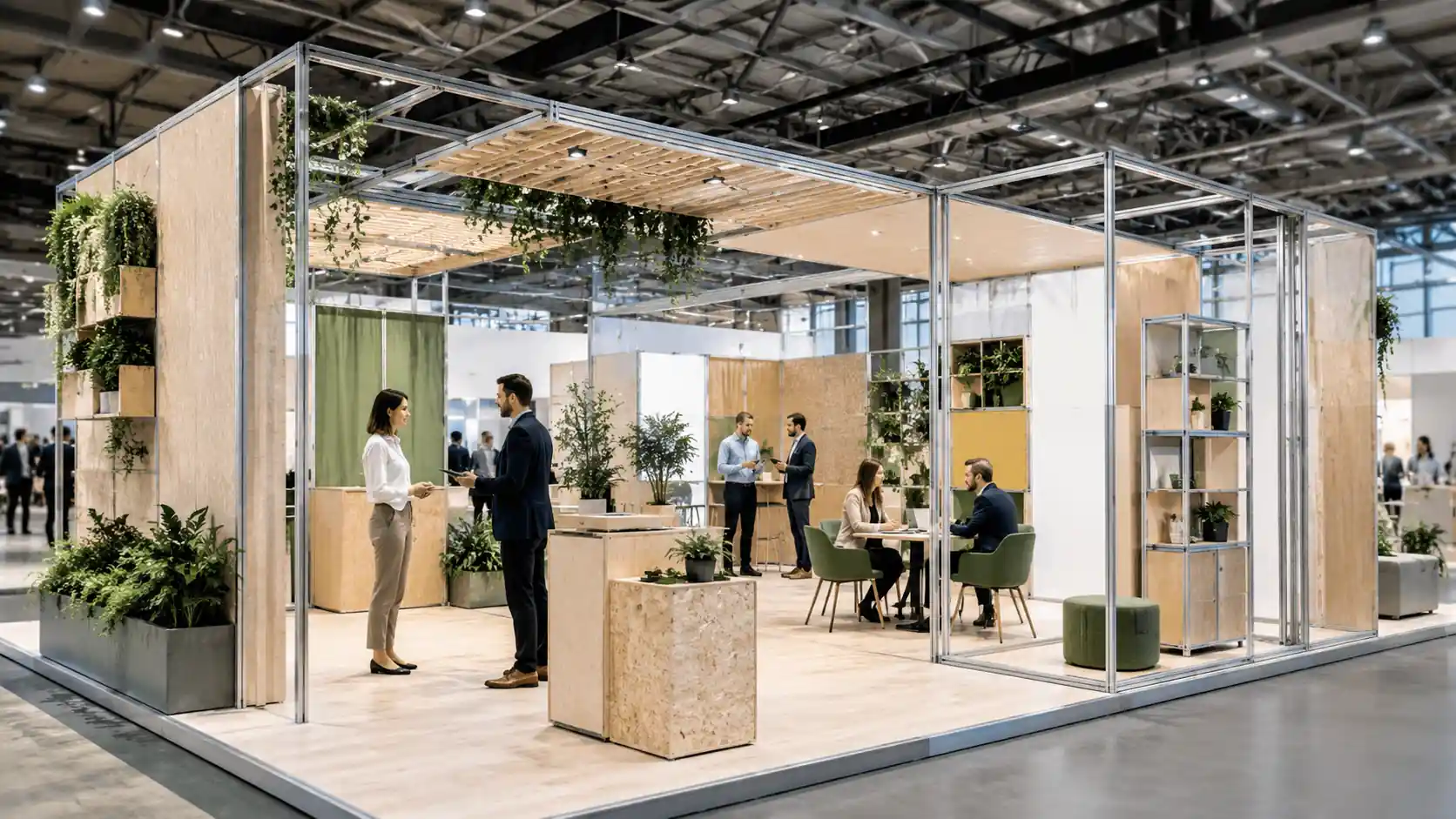
Why Modularity Is Transforming Booth Manufacturing
Trade show participation can no longer be approached as a series of isolated projects. Many companies exhibit several times a year, move between venues, reserve different booth sizes, and need to adapt their communication to new products, markets, and audiences.
In this context, modular systems provide both a technical and strategic solution. They make it possible to create custom spaces using components that can be disassembled, transported, maintained, and reorganized for different events.
Modularity does not mean using a generic booth. A well-designed modular system can integrate custom architecture, interchangeable graphics, lighting, furniture, audiovisual areas, and proprietary brand elements.
The key is to distinguish between the permanent structure and the layers that need to change. The structure, connections, and certain brand assets can be reused. Signage, messaging, layout, and selected finishes can be modified for each trade show.
This approach connects three common goals in booth manufacturing: adapting to different spaces, controlling total cost, and reducing resource consumption. It also supports the development of reusable booths and, when the footprint and venue regulations allow, the integration of modular mezzanines to increase usable space.
What Is a Modular Booth System?
Modular booth system (definition): a set of structural and functional components designed to be combined, disassembled, and reconfigured across different exhibit spaces.
A modular system may include:
- Structural profiles: typically used to build walls, frames, portals, and supports.
- Panels: opaque, translucent, graphic, or decorative surfaces.
- Connectors: components that make it possible to join modules precisely and repeat configurations.
- Interchangeable graphics: fabrics, panels, or visual media that can be updated.
- Lighting: integrated systems that can be removed and reinstalled.
- Modular furniture: counters, display cases, product displays, and storage units.
- Elevated elements: portals, suspended structures, or mezzanines when permitted.
The defining feature is not the booth’s shape, but its ability to evolve without having to manufacture every component from scratch.
The Value Framework of Modular Booths
The usefulness of a modular system can be assessed through four connected variables:
- Adaptability: the ability to change size, layout, and function.
- Reuse: the possibility of using components across multiple events.
- Efficiency: reduced installation time, fewer issues, and less repeated fabrication.
- Traceability: control over inventory, maintenance, usage, and the destination of each component.
These variables reinforce one another. An adaptable booth can be reused more often. Greater reuse improves the return on the investment. A well-documented inventory makes adaptation easier and prevents the unnecessary fabrication of components that already exist.
For this reason, modularity should not be evaluated solely by its initial price. It should be assessed as a multi-use system.
Adaptability: One Structure for Different Trade Shows and Footprints
A company may reserve 260 square feet at a domestic trade show and 650 square feet at an international event. It may also move from an inline booth to a corner space or an island booth open on all four sides.
A modular system makes it possible to prepare different configurations from a shared base. To achieve this, the project must define from the outset which components will remain fixed and which will vary.
Elements Worth Keeping
- Main structures.
- Profiles and connection systems.
- Reusable dimensional signs.
- Lighting equipment.
- Technical furniture.
- Audiovisual elements.
Elements That Can Change
- Campaign graphics.
- Interior layout.
- Sales messages.
- Displayed products.
- Number of meeting stations.
- Demonstration areas.
This separation allows the booth to adapt without losing brand consistency. The company retains a recognizable identity while modifying the space according to the objective of each event.
Reusable Booths: What True Reuse Means
A booth does not become sustainable simply because it can be disassembled. True reuse requires its components to be preserved in suitable condition and used again for an equivalent purpose.
Reusable booth (definition): an exhibit space whose components retain their technical and commercial usefulness across multiple installations, with controlled adaptations and without replacing most of the structure.
For reusable booths to work effectively, they should include:
- Design for disassembly: reversible connections that do not damage components.
- Durable materials: parts capable of withstanding handling, transportation, and storage.
- Logistics protection: appropriate packaging to prevent impact, moisture, or deformation.
- Inventory control: identification of parts, quantities, dimensions, and condition.
- Maintenance: cleaning, repair, and selective replacement of components.
- Reuse planning: anticipation of future booth sizes and configurations.
A component that remains in storage and is never used again does not create a circular advantage. Reuse must be tied to a real event schedule.
Why a Modular System Can Be More Sustainable
The sustainability of a booth depends on its entire life cycle. Material extraction, manufacturing, transportation, installations, maintenance, and end-of-life treatment must all be considered.
Modular systems can improve this cycle because they allow components to remain in use longer, make it possible to repair individual parts, and avoid manufacturing a completely new booth for every trade show.
However, modularity and sustainability are not automatically the same thing. A modular system transported over long distances, stored inefficiently, or replaced prematurely may lose part of its advantage.
A rigorous analysis should consider the following factors:
- Number of reuses: the more times the structure is effectively used, the better the investment is leveraged.
- Transportation volume: compact components can reduce logistics requirements.
- Durability: a strong component avoids frequent replacement.
- Repairability: damaged parts should be replaceable without discarding the entire system.
- Material separation: supports maintenance and end-of-life processing.
- Upgradability: graphics and technology should be replaceable without discarding the structure.
This approach is consistent with Europe’s broader shift toward products that are more durable, reusable, repairable, and recyclable. It does not mean there is one universal rule requiring modular booths, but modularity makes it easier to apply circular economy principles to the trade show industry.
The Five-Action Method for a Sustainable Modular Booth
A practical framework for evaluating a modular system is to apply five actions:
- Reduce: eliminate unnecessary components and optimize material use.
- Reuse: retain structures, lighting, furniture, and brand elements.
- Reconfigure: adapt modules to different footprints and goals.
- Repair: replace only damaged or outdated parts.
- Recover: separate materials and components at the end of their useful life.
This method can be applied both to the booth as a whole and to each individual component. A counter, for example, should use only the material required, work across different installations, accept graphic updates, be repairable, and have a defined destination once it is no longer functional.
How Modular Booths Are Manufactured
Modular booth manufacturing requires more initial planning than a solution designed for a single event. Every component must serve a current purpose and have potential value in future configurations.
1. Define the Trade Show Program
Before designing, it is useful to understand how many events the company will attend, the booth sizes it typically reserves, and the functions it needs to maintain.
2. Create a Modular Grid
Dimensions, heights, and combination rules are established. The grid should support multiple configurations without creating too many custom parts.
3. Design the Components
Walls, frames, storage rooms, counters, graphic supports, and connection elements are developed. Each component must be compatible with the others.
4. Technical Modeling
CAD tools make it possible to define geometries, connections, and parts. Integration with CAM processes can support the precise manufacturing of panels, furniture, and custom components.
5. Preassembly
Workshop preassembly makes it possible to test fit, stability, graphics, lighting, and installation order.
6. Identification and Inventory
Each component receives a reference number. The inventory documents its dimensions, material, condition, location, and compatible configurations.
7. Sequence-Based Packaging
Components should be loaded and labeled according to the order in which they will be needed during installation.
Modular Booth vs. Custom Booth vs. Hybrid Solution
There is no single system that is right for every company. The choice depends on the event schedule, brand positioning, and level of customization required.
Modular Booth
- Main advantage: high potential for reuse and adaptation.
- Best application: companies that attend multiple trade shows.
- Limitation: the design must follow compatibility rules.
Single-Use Custom Booth
- Main advantage: maximum creative freedom for a specific location.
- Best application: major launches or one-of-a-kind experiences.
- Limitation: lower reuse potential if disassembly is not planned.
Hybrid Booth
- Main advantage: combines a reusable structure with custom elements.
- Best application: brands seeking both differentiation and efficiency.
- Limitation: requires coordination so custom parts do not restrict future adaptations.
In many projects, the hybrid model provides an effective balance. It preserves the technical core while allowing the highest-impact visual elements to be renewed.
How to Calculate the Profitability of a Reusable Booth
The budget should be analyzed through total cost of ownership rather than the initial manufacturing invoice alone.
Total cost per use (definition): the combined cost of design, manufacturing, adaptations, transportation, installation, storage, and maintenance divided by the number of events completed.
To compare alternatives, include:
- Initial investment.
- Adaptation cost per trade show.
- Graphic updates.
- Transportation and handling.
- Installation and dismantling.
- Storage.
- Maintenance and repairs.
- Residual value of components.
A modular booth may require a higher initial investment than a basic temporary solution. However, it may become more competitive when that cost is spread across multiple events.
Profitability depends on actual use. If a company completely changes its identity or requirements for every trade show, the payback will differ from that of a brand with a stable exhibit strategy.
Modular Mezzanines: Expanding Usable Booth Space
Modular mezzanines are demountable elevated structures that create a second level within a booth. They can be used for meetings, hospitality, offices, or private client areas.
Their main advantage is the ability to increase functional space without expanding the rented footprint. However, they are not an automatic solution and are not suitable for every booth.
Technical Factors That Must Be Reviewed
- Venue approval: the organizer must allow two-story structures.
- Structural engineering: the structure must be justified for the expected loads.
- Available height: maximum heights and required clearances must be respected.
- Egress: stairs, travel paths, and exits must meet applicable requirements.
- Fire protection: materials, detection, suppression, and covered areas may be subject to specific conditions.
- Accessibility: equivalent functions should be provided for visitors who cannot use the stairs.
- Visibility: the mezzanine should not unnecessarily obscure the brand or close off access to the booth.
Modular mezzanines can be reused when they are designed with standardized components and properly documented. However, every new configuration must be reviewed according to the booth footprint, event regulations, and actual loads.
When a Modular Mezzanine Makes Sense
A second level may be appropriate when:
- The booth footprint is large enough to accommodate stairs and structure.
- There is a real need for private meetings.
- The cost of additional floor space is high.
- The event schedule includes several compatible trade shows.
- The permitted height creates additional brand visibility.
It is usually not the best option when the booth is too small, deadlines are extremely tight, or venue restrictions make the project excessively complex.
Graphic Design and Signage in Modular Systems
Visual customization is essential to prevent a modular booth from looking generic.
The most common solutions include:
- Interchangeable fabric graphics: lightweight, transportable, and adaptable to frames.
- Replaceable vinyl graphics: suitable for campaigns and temporary messages.
- Rigid panels: help maintain consistent finishes.
- Dimensional signs: reinforce recognition and can be reused.
- Integrated lighting: transforms perception without changing the structure.
- Digital screens: allow content to be updated for each event.
Graphics should be designed by zones and standardized formats. This makes it easier to replace one campaign without reproducing every visual surface.
Logistics and Storage for Reusable Booths
The durability of a modular system depends heavily on how it is handled outside the event.
Logistics Best Practices
- Use reusable packaging adapted to each component.
- Protect visible surfaces and electrical equipment.
- Label packages by booth area and installation sequence.
- Track warehouse check-in and check-out.
- Inspect components after every dismantling.
- Repair damage before the next shipment.
- Optimize freight volume.
Storage should not be a passive space. It should function as a control point where inventory is reviewed and the next configuration is prepared.
Metrics for Measuring the Sustainability of a Modular Booth
Sustainability should be supported by verifiable data rather than general claims.
Useful indicators include:
- Number of installations: how many times each system is used.
- Percentage of reused components: the share of the previous booth incorporated into the new installation.
- Repaired parts: components recovered compared with components replaced.
- New material per event: the amount required for each adaptation.
- Waste generated: materials discarded during manufacturing and dismantling.
- Transportation volume: logistics space required by each configuration.
- Cost per use: accumulated investment divided by completed events.
These data make it possible to compare projects, identify improvements, and justify purchasing decisions more rigorously.
Common Mistakes When Designing Modular Booths
- Confusing modular with generic: a reusable system must still reflect the brand identity.
- Failing to plan for future footprints: limits adaptability.
- Creating too many custom parts: increases cost and reduces compatibility.
- Neglecting packaging: shortens the useful life of components.
- Not maintaining an inventory: leads to losses and duplicate purchases.
- Claiming sustainability without measuring it: creates statements that are difficult to verify.
- Reusing without inspection: may carry damage or safety issues into the next event.
- Adding mezzanines without planning: can cause technical or documentation conflicts.
How to Choose a Modular System for Your Trade Show Schedule
The decision can be organized into seven steps:
- Step 1: list the trade shows planned for the next twelve or twenty-four months.
- Step 2: categorize the most common booth sizes and locations.
- Step 3: define permanent functions: reception, meetings, product display, and storage.
- Step 4: separate reusable assets from temporary content.
- Step 5: design multiple configurations using the same inventory.
- Step 6: calculate total cost per use, logistics, and storage.
- Step 7: establish reuse, maintenance, and waste indicators.
This process prevents the system from being selected solely from a catalog or based on initial cost. The solution must respond to the company’s actual event program.
How Full-Expo Can Support Modular Booth Manufacturing
Full-Expo can integrate modularity from the strategy stage through final installation. The goal is to ensure that the system responds to both current needs and future trade show participation.
The project may include:
- Trade show schedule analysis: booth sizes, cities, goals, and frequency of use.
- Custom modular design: configurations adapted to the corporate identity.
- Advanced manufacturing: precise production of structures, panels, and custom components.
- Interchangeable graphics: campaign updates without replacing the structure.
- Modular mezzanines: development and technical coordination when permitted by the venue and project.
- Installation across Europe: transportation, setup, and dismantling planning.
- Inventory and storage: component control for future reuse.
- Maintenance: inspection and repair between events.
Full-service management reduces the number of interfaces between design, workshop, logistics, and installation. It also makes it easier to maintain consistent documentation for each component and its possible configurations.
Conclusion: Adaptability, Sustainability, and Performance Form One System
Modular systems create value when they connect adaptability, reuse, efficiency, and traceability. The goal is not to repeat exactly the same booth, but to retain useful components and reorganize them for each event.
In booth manufacturing, this strategy makes it possible to design structures for different spaces, update communication, and better control accumulated costs.
Reusable booths can reduce the need to manufacture new components, but their performance depends on planning, maintenance, logistics, and the actual number of uses.
Modular mezzanines add another layer of adaptability by expanding functional space. They must be approached with particular technical, structural, and regulatory rigor.
Sustainability does not come from a label. It comes from verifiable decisions throughout the entire life cycle: designing for disassembly, reusing with purpose, repairing before replacing, and documenting results.
Full-Expo can help turn these principles into a custom exhibit system capable of evolving from one trade show to the next without losing identity, quality, or functionality.
Request a quote from Full-Expo and explore which modular configuration can provide the best balance of impact, reuse, and total cost for your upcoming event schedule.
Frequently Asked Questions About Modular Booth Systems (FAQs)
It is a booth made from demountable, combinable components that can be reorganized to fit different booth sizes, layouts, and events.
They make it possible to reuse structures, lighting, furniture, and brand elements across multiple trade shows, reducing repeated fabrication and spreading the investment over more uses.
Yes. It can incorporate custom finishes, graphics, signage, furniture, and architectural elements without losing its adaptability.
It depends on the material, design, handling, and maintenance. Its useful life should be assessed through inspections after every installation.
It is a demountable elevated structure that creates a second level for meetings, hospitality, or other functions within the booth.
No. Its feasibility depends on the booth size, available height, venue regulations, structural engineering, and egress and safety requirements.
They do not always have a lower initial cost, but they can reduce the cost per event when reused strategically across multiple trade shows.
Through interchangeable graphics, dimensional signs, lighting, furniture, decorative panels, and layouts adapted to each event.
Measure the number of uses, percentage of reused components, repairs, new materials, waste generated, and transportation requirements.
It requires cleaning, inspection of connections, electrical checks, finish repairs, inventory updates, and proper protection during storage.