
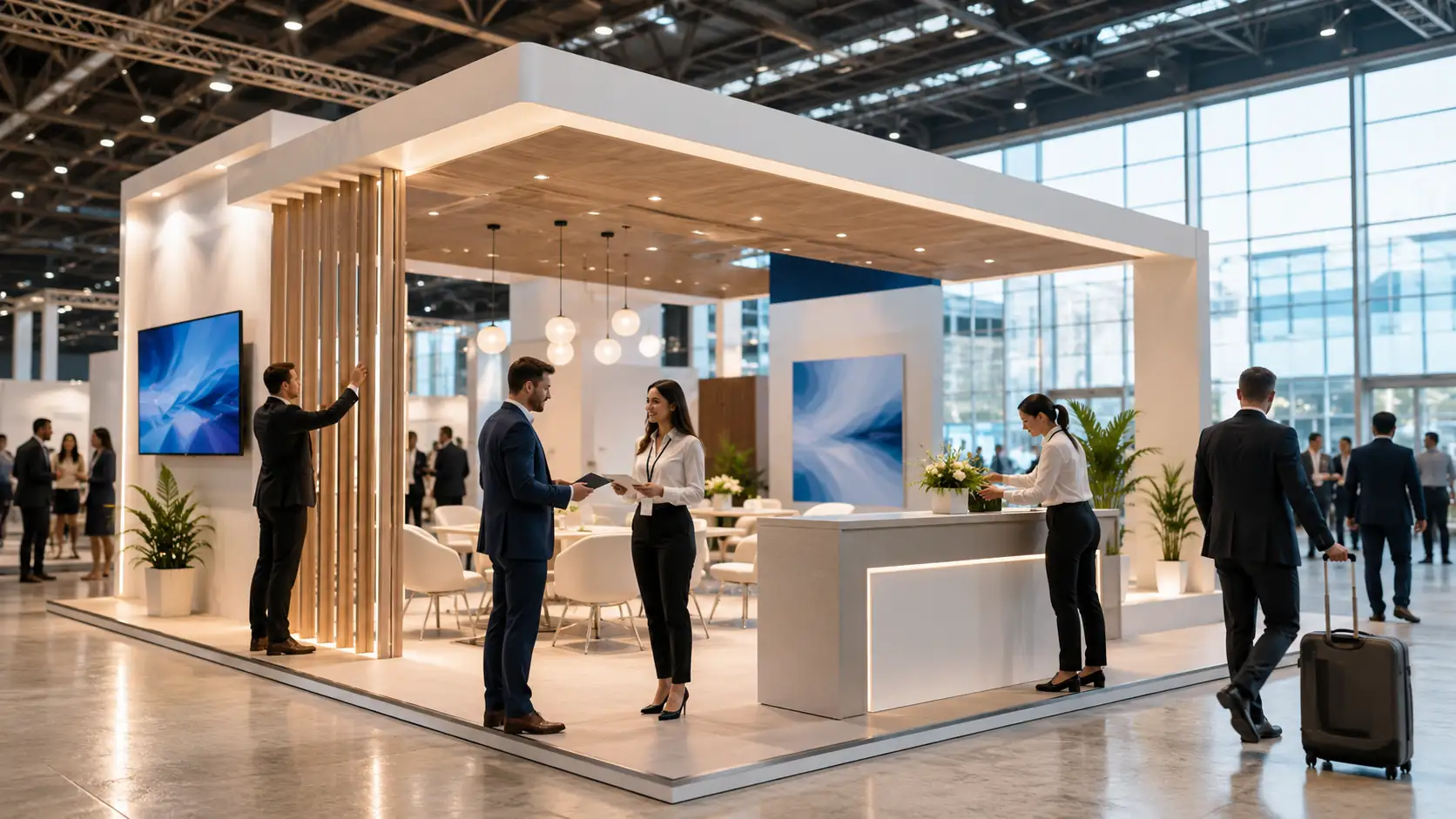
Why Installation Determines the Success of an International Booth
Participating in an international conference does not end when the booth design is approved. The decisive moment comes when that project must be transported, built, inspected, and delivered inside a venue abroad while meeting strict deadlines and specific technical requirements.
Booth installation is the process that turns a design concept into a safe, functional space that is ready to receive visitors. It involves much more than assembling structures. It requires coordination across production, transportation, venue access, crews, electrical systems, signage, furniture, cleaning, and quality control.
The complexity increases when dealing with conference booths held outside the company’s home country. Each venue may establish different rules regarding height limits, loads, materials, schedules, credentials, risk prevention, suspended elements, or electrical service.
For this reason, trade show booth construction in Europe must be approached as a coordinated system. The goal is not simply to finish on time, but to deliver a space that is consistent with the brand, compliant with event requirements, and ready to serve a commercial purpose.
This article explains how to organize that system and how a specialized team such as Full-Expo can reduce uncertainty throughout every phase of the project.
What Booth Installation Really Includes
Booth installation (definition): the set of technical, logistical, and human operations required to install an exhibit space inside a trade show or conference venue and leave it fully prepared for use.
A professional installation usually includes the following activities:
- Receiving and unloading: arrival of structures, graphics, furniture, and equipment.
- Layout marking: verification of dimensions and positioning within the rented booth space.
- Construction: assembly of walls, platforms, ceilings, and architectural elements.
- Technical systems: electrical distribution, lighting, audiovisual equipment, and technical connections.
- Signage: installation of vinyl graphics, fabrics, dimensional signs, and wayfinding.
- Furnishing: placement of furniture, display units, and meeting areas.
- Final inspection: review of stability, finishes, functionality, and cleanliness.
These operations must be performed in a logical sequence. If one phase moves forward or falls behind without coordination, it can block other crews and create additional costs.
The Framework for a Hassle-Free International Installation
A reliable international project is built on four connected pillars:
- Planning: define requirements, dates, responsibilities, and dependencies.
- Production: manufacture precise, labeled components prepared for installation.
- Coordination: synchronize the venue, transportation, technicians, suppliers, and client.
- Verification: confirm that the final result meets the design, regulations, and commercial purpose.
This framework applies to the entire project. It is also repeated within each individual task. Installing a sign, for example, requires planning its location and anchoring, producing it correctly, coordinating it with the electrical team, and verifying the lighting.
The absence of any one of these four pillars increases the risk of improvisation. A booth may be well designed but still fail if its components arrive without proper labeling. It may also be well manufactured but delayed because crew access was not requested on time.
Advance Planning for International Conference Booths
Preparation should begin as soon as participation is confirmed. Waiting until the design is complete before reviewing the venue documentation is usually a mistake.
Review the Conference Technical Manual
The organizer or venue usually provides specific documentation for exhibitors and installers. It may define:
- Maximum permitted heights.
- Construction restrictions.
- Fire-performance requirements for materials.
- Allowable floor loads.
- Rules for ceilings, double-deck structures, and suspended elements.
- Move-in and move-out schedules.
- Vehicle and personnel access procedures.
- Mandatory services contracted through official providers.
These rules are not identical at every conference. Automatically reusing documentation from a previous event can therefore lead to errors.
Define a Responsibility Matrix
Every task should have a clearly assigned owner. An operational matrix may include:
- Client: content, products, approvals, and commercial requirements.
- Project manager: schedule, budget, suppliers, and communication.
- Production team: fabrication, preparation, and component quality control.
- Logistics team: packing, transportation, unloading, and return shipping.
- Installation crew: technical execution inside the venue.
- Organizer: permits, services, and documentation approval.
This allocation prevents duplication and reduces the risk of leaving a critical task unfinished.
Designing with Booth Installation in Mind
Efficient installation begins during the design phase. Creating an attractive concept is not enough. The project must also be manufacturable, transportable, and installable within the available time.
Installation-Oriented Design Principles
- Modularity: divide the booth into manageable, reusable components.
- Accessibility: provide access to wiring, lighting, and technical equipment.
- Logical sequencing: design components that can be assembled without blocking later tasks.
- Stability: resolve supports, anchors, connections, and load distribution.
- Transportability: adapt dimensions to the planned packaging and vehicle.
- Maintenance: allow replacements and repairs during the event.
A design that ignores these variables may require improvised modifications at the venue. These corrections are usually more expensive and less precise than a solution planned in the workshop.
Precise Production to Reduce On-Site Issues
Fabrication determines how easily the crew will be able to execute the installation. Components must arrive complete, inspected, and organized according to the installation sequence.
Technical Preparation Before Transportation
- Check dimensions and tolerances.
- Preassemble components when necessary.
- Test lighting systems.
- Review finishes and colors.
- Label every component.
- Separate tools, consumables, and spare parts.
- Prepare updated installation drawings.
Preassembly makes it possible to detect incompatibilities before materials leave the workshop. This practice is especially useful for illuminated signs, custom furniture, special structures, and complex modular systems.
Labeling and Traceability
Every package and component should have an unambiguous reference. A simple system may indicate:
- Project number.
- Booth area.
- Installation sequence.
- Package contents.
- Special handling requirements.
Traceability reduces the time spent locating components and makes it easier to confirm that the shipment is complete.
Logistics for Trade Show Booth Construction in Europe
International logistics involves much more than booking a truck. Transportation must be coordinated with venue access windows, urban restrictions, unloading operations, and crew availability.
Variables That Must Be Controlled
- Route: distance, tolls, restrictions, and driver hours.
- Unloading window: the date and time assigned by the venue.
- Documentation: delivery notes, inventory, credentials, and permits.
- Material handling: need for forklifts, cranes, or official venue equipment.
- Storage: destination of empty packaging during the conference.
- Return logistics: material removal and subsequent delivery.
For trade show booth construction in Europe, the status of traveling personnel must also be reviewed. Depending on the country and the length of the assignment, prior notification, employment documentation, social security coverage, or compliance with host-country working conditions may be required.
This administration must be completed before travel. Trying to resolve documentation once the crew is already at the venue can cause delays or prevent access altogether.
The Booth Installation Sequence, Step by Step
The exact sequence depends on the design, but a typical workflow includes the following phases:
1. Booth Space Handover
The location, dimensions, contracted services, and condition of the floor are checked. Any discrepancy should be documented before work begins.
2. Layout Marking
Measurements from the plans are transferred to the actual space. This phase establishes the position of walls, storage areas, entrances, and technical points.
3. Flooring Installation
When a platform or raised technical floor is required, it is installed before structures are erected. Planned cable routes are also prepared at this stage.
4. Wall and Structural Assembly
The main modules are assembled, vertical alignment and stability are checked, and supports for graphics and lighting are prepared.
5. Technical Installations
Electrical systems, lighting, audiovisual equipment, and other connections are installed. The work must be coordinated so that final finishes do not block necessary access points.
6. Finishes and Signage
Vinyl graphics, fabric graphics, dimensional signs, decorative elements, and wayfinding are installed. Surfaces must be clean and properly prepared.
7. Furniture and Products
Reception, meeting, product display, and storage areas are organized. The layout must preserve the planned circulation paths.
8. Verification and Handover
The complete booth is reviewed using a checklist. The goal is to identify any issue before the client arrives or the conference opens.
Quality Control Before the Conference Opens
A booth is not finished when construction ends. It is finished when it can be used safely and fulfills its communication purpose.
Technical Handover Checklist
- The structure is stable and shows no abnormal movement.
- Entrances and circulation paths are free of obstacles.
- The electrical system functions correctly.
- Light fixtures are aimed according to the design.
- Screens and audiovisual equipment play the required content.
- Signs are visible from the intended aisles.
- Graphics are aligned and free of noticeable defects.
- Furniture is complete and correctly positioned.
- The storage area supports organized work.
- The space is clean and ready to receive visitors.
This inspection should be documented. Final photographs help verify the result and provide a reference for future installations.
How to Adapt Installation for International Conferences
Conferences often have different requirements from large industrial trade shows. The space may be smaller, installation windows shorter, and interaction more focused on meetings, education, or brief demonstrations.
Common Features of Conference Booths
- Compact footprints.
- Strong need for concealed storage.
- Highly readable signage.
- Areas for demonstrations or presentations.
- Professional conversation spaces.
- Especially fast installation and dismantling.
The best conference booths give every square foot a clear purpose. An efficient design avoids wasted areas and allows the team to assist several visitors without creating congestion.
In-House Installation, Multiple Vendors, or Full-Service Management
There are three common models for executing an international project:
Direct Management by the Exhibitor
The company coordinates design, transportation, installation, and venue services. This may be viable for simple projects, but it requires venue knowledge and internal availability.
Coordination of Multiple Vendors
Each specialty is contracted separately. This makes it possible to choose specific suppliers, but it increases the number of interfaces and the risk of coordination failures.
Specialized Full-Service Management
A single partner coordinates design, production, logistics, installation, and dismantling. This model simplifies communication and makes responsibilities easier to assign.
The best option depends on the scope, but for complex international projects, full-service management generally reduces operational friction.
Common Mistakes in International Booth Installation
- Reviewing regulations too late: may require changes to structures that have already been manufactured.
- Failing to confirm services: may result in missing electrical capacity, connections, or equipment.
- Poor packaging: increases damage and losses during transportation.
- Unlabeled components: slows installation and increases the likelihood of errors.
- Outdated drawings: creates contradictions between the workshop and the venue.
- No spare parts: turns minor issues into critical problems.
- No dismantling plan: leads to losses, damage, or removal fees.
Most of these issues are not solved by working faster. They are prevented through planning and control.
How to Measure Installation Efficiency
Installation can also be evaluated using operational indicators:
- Schedule compliance: delivery within the agreed time window.
- Cost variance: difference between the planned budget and final expenditure.
- Number of incidents: problems identified during installation and opening.
- Rework hours: time spent correcting errors.
- Reuse rate: percentage of components recovered for future events.
- Dismantling time: efficiency in removal, inventory, and loading.
These data points help improve the next project and support better decisions regarding design, materials, packaging, and crew structure.
How Full-Expo Simplifies Conference Booth Installation
Full-Expo approaches the project as a complete chain. Design is coordinated with production, logistics, and installation to reduce incompatibilities between phases.
The service may include:
- Custom technical and creative design.
- Fabrication and workshop preassembly.
- International logistics planning.
- Documentation management and venue coordination.
- Installation by specialized crews.
- Installation of graphics, signage, and furniture.
- Quality control and final handover.
- Dismantling, return shipping, and storage.
This approach provides one central point of contact throughout the project. The exhibiting company can focus on its commercial strategy, content, and meetings while the technical team manages physical execution.
Conclusion: Hassle-Free Installation Is Built Before Reaching the Venue
The success of booth installation does not depend on solving problems quickly during setup. It depends on eliminating as much uncertainty as possible beforehand.
A reliable project connects planning, fabrication, logistics, coordination, and verification. Each phase prepares the next and allows the team to work with realistic information, resources, and timelines.
This methodology is especially important for trade show booth construction in Europe, where each country, organizer, and venue may apply different operational requirements.
Conference booths must be visible, functional, and commercially effective, but they must also arrive complete, be installed accurately, and be delivered on time.
Working with a specialized team such as Full-Expo makes it possible to centralize the process and reduce the exhibitor’s coordination workload. The result is a booth that is ready to represent the brand and support business opportunities from the first minute of the conference.
Request a quote from Full-Expo and plan your next international booth with a team capable of coordinating design, production, transportation, and installation from start to finish.
Frequently Asked Questions About Conference Booth Installation (FAQs)
It depends on the size, complexity, and venue schedule. A small modular booth may be installed quickly, while a custom project may require several days.
Services may include unloading, construction, electrical work, lighting, signage, furniture, final inspection, dismantling, and coordination with the organizer.
Installers may need credentials, insurance, employment documentation, risk assessments, and technical forms. Requirements vary by country and venue.
Review venue regulations, confirm access, manufacture accurately, label components, and coordinate all technical services in advance.
Modular installation uses standardized, reusable components. Custom construction creates specific elements for a brand, space, or experience.
Yes. It should be designed with adaptable modules, interchangeable graphics, appropriate packaging, and an inventory system that supports maintenance.
Coordination may be handled by the exhibitor, its agency, or a full-service booth company. Centralizing it reduces errors and makes deadlines easier to meet.
Planning should begin as soon as participation is confirmed. Complex projects need sufficient time for design, permits, production, logistics, and technical adjustments.