Promoting your booth starts before the trade show
A booth can be perfectly designed and located in a high-traffic exhibit hall, but that alone does not guarantee a steady flow of qualified visitors. Attendance needs to be cultivated before the event begins and maintained throughout the show. Social media makes it possible to extend the physical reach of trade show booths and connect the in-person experience with a much larger digital audience.
Promoting a booth on social media is not simply a matter of posting a photo with the message “we’ll be at the trade show”. An effective strategy should build anticipation, explain why the booth is worth visiting, make it easy to find, document what happens during the event, and extend conversations after the show ends.
The process can be summarized in four functions: attract, guide, activate, and extend. Before the trade show, social media attracts. Once the event begins, it helps guide visitors. During the show, it activates conversations and amplifies the experience. Afterward, it extends the life of the content and the business opportunities generated.
This approach should also connect with the booth’s design, branding, and trade show signage. What someone sees on LinkedIn or Instagram should be recognizable when they arrive at the exhibit hall. The digital campaign and the physical space should be part of the same brand experience.
Why social media matters for professional trade shows
Social media provides a direct channel for communicating trade show participation to customers, contacts, distributors, suppliers, and potential buyers. Its value increases when the company treats the event as a campaign rather than as an isolated activity.
Spain’s digital landscape illustrates the potential scale of these channels. DataReportal’s Digital 2026 report, based primarily on data available at the end of 2025, estimated 39 million social media user identities in Spain. In the advertising tools analyzed in the report, Instagram reached 26.4 million users, while LinkedIn reported 24 million registered members in Spain. Because the two platforms use different methodologies, these figures should not be compared directly as equivalent active-user totals.
For a B2B company, the important point is not reaching millions of people. It is identifying where the relevant professional audience is and assigning a specific role to each social platform.
Definition: what is a social media strategy for promoting a trade show booth?
Trade show social media strategy (definition): coordinated planning of digital content and actions designed to increase exhibitor visibility, attract relevant visitors to the booth, and extend business opportunities before, during, and after an event.
A complete strategy should answer five questions:
- Who: which audience do we want to attract?
- Why: what real reason do they have to visit the booth?
- Where: which platforms does that audience use?
- When: what message do they need at each stage of the trade show?
- What action: visit the booth, book a meeting, attend a demo, or request information?
These five variables should remain connected throughout the campaign.
1. Define an objective before creating content
The first step is deciding what result the campaign should generate. UFI’s own trade show planning methodologies emphasize that effective participation requires clearly defined objectives in advance, since those objectives shape preparation and make it possible to evaluate results afterward.
Social media objectives may include:
- Increase awareness of the company’s participation in the trade show.
- Drive visitors to the booth.
- Book sales meetings.
- Promote a product launch.
- Attract attendees to a demonstration.
- Strengthen brand positioning.
- Generate new professional contacts.
The objective changes the content strategy. If meetings are the priority, posts should direct users to a scheduling page. If the company is launching an innovation, the campaign can build anticipation through a sequence of previews and teasers.
2. Choose social platforms based on the trade show audience
There is no need to publish the same content on every platform. Each channel should have a specific purpose.
LinkedIn for B2B professional relationships
LinkedIn is often particularly useful for industrial, technology, and professional trade shows. It allows companies to communicate their participation to decision-makers, buyers, industry professionals, and business contacts.
It can be used to:
- Announce participation in the event.
- Introduce the team that will be at the booth.
- Promote meeting opportunities.
- Explain products or solutions.
- Share professional insights during the trade show.
Instagram for visual impact
Instagram is especially useful when the booth itself, the product, or the visitor experience has a strong visual component.
Content can include:
- Fabrication process.
- Time-lapse booth installation.
- Signage details.
- Reels of the completed booth.
- Stories during the event.
- Short demonstrations.
Other platforms
TikTok may make sense for video content in industries with compatible audiences. YouTube is useful for longer explanatory videos, demonstrations, and interviews. X can help follow real-time conversations at events where an active community is present.
Platform selection should be based on the audience rather than on the overall popularity of each social network.
3. Build a three-phase campaign: before, during, and after
The most effective promotion treats the trade show as a sequence rather than as a single moment.
- Before: build anticipation and book meetings.
- During: increase booth traffic and document activity.
- After: turn content and interactions into continued business opportunities.
Each stage uses different messages, but all three should maintain the same visual identity and value proposition.
How to promote your booth before the trade show
The pre-show phase allows you to compete for an especially limited resource: the visitor’s schedule. Many professionals arrive at a major trade show with meetings already booked and a list of companies they intend to visit.
Four to six weeks before the event
Announce your participation and explain why it will be relevant.
Include:
- Trade show name.
- Dates.
- City.
- Hall and booth number once confirmed.
- Main product launch, innovation, or value proposition.
Two to three weeks before the event
The content should shift from informing to persuading.
It can highlight:
- Products visitors will be able to try.
- Scheduled demonstrations.
- Experts available at the booth.
- New products or solutions being presented.
- A calendar for booking meetings.
During the final week
The priority is making the visit as easy as possible.
Remind your audience of:
- Exact location.
- Hours.
- Special activities.
- How to schedule a meeting.
The post should clearly answer the question: why should this booth be part of my trade show itinerary?
What types of content generate interest?
A campaign needs variety without losing consistency. A useful framework is to combine five types of content.
Educational content
Explain something relevant to the audience, such as an industry challenge, a solution, or a specific application.
Product content
Show what visitors will be able to experience or discover in person.
People-focused content
Introduce the people who will be available for meetings, demonstrations, or consultations.
Behind-the-scenes content
Show how the event is prepared, including fabrication, printing, transportation, or installation.
Experience-focused content
Preview what will happen at the booth and give visitors a concrete reason to stop by.
This combination prevents the entire content calendar from becoming a series of repetitive promotional messages.
How to use signage to connect social media with the physical booth
Trade show signage plays an important role in creating continuity between the digital campaign and the in-person experience.
If social media posts use a particular visual concept, that concept should also be recognizable at the booth through:
- Colors and graphic elements.
- Core messaging.
- Photography.
- Logo.
- Dimensional signage.
- Screens and digital elements.
This continuity makes recognition easier. Someone who has seen several social posts may identify the booth more quickly while walking through the exhibit hall.
Signage can also be designed with content creation in mind. A well-lit backdrop, a visually clean product area, or a recognizable brand feature can make it easier to produce consistent photos and videos.
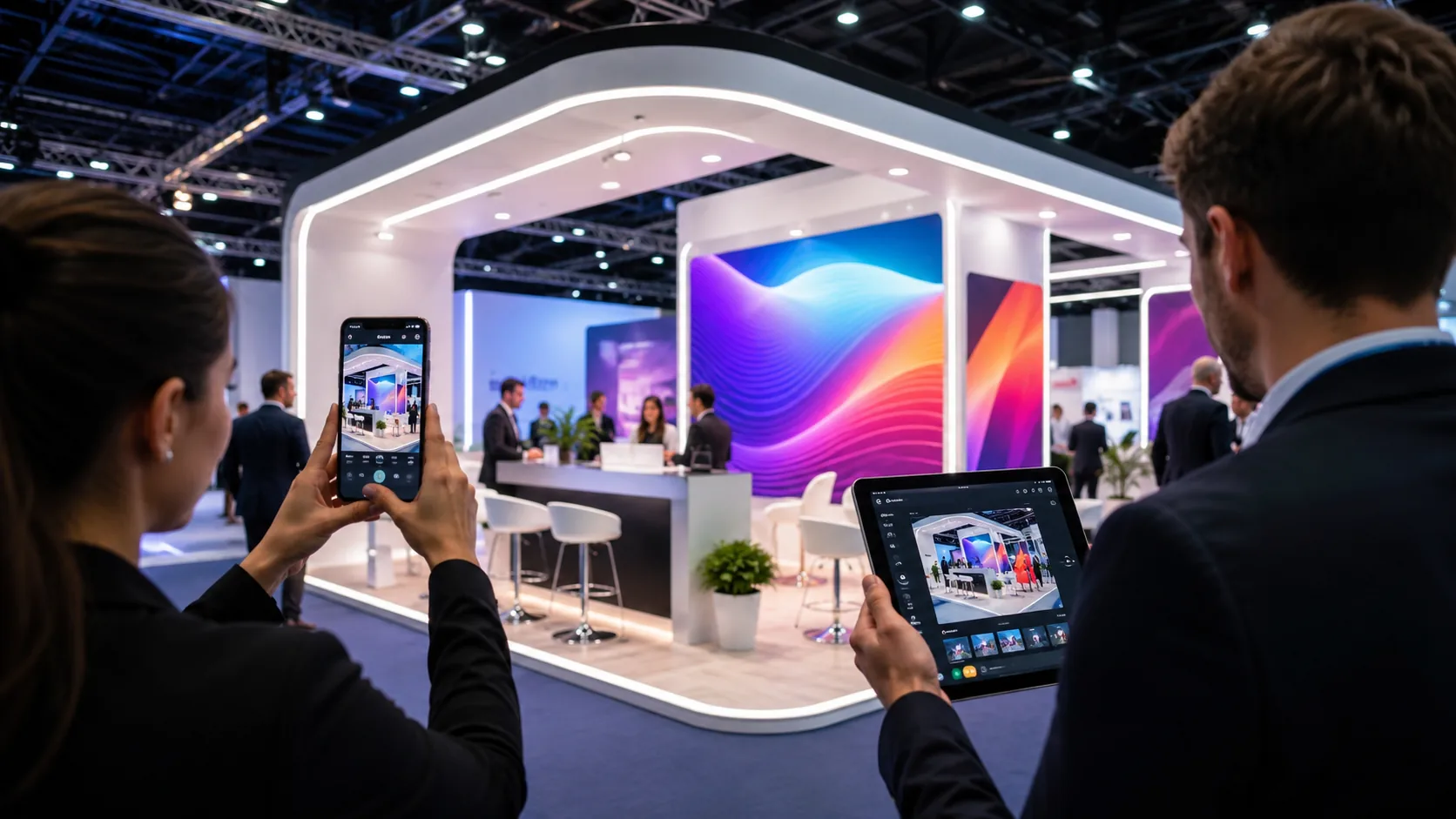
Design trade show booths that also work on camera
Social media turns the booth into a setting for audiovisual content. For that reason, the design process should consider how the space will look in photography and vertical video.
Some practical criteria include:
- Create at least one recognizable branded focal point.
- Avoid overly busy backgrounds.
- Properly light areas intended for filming.
- Keep logos visible without relying on a single camera angle.
- Allow enough space for demonstrations.
- Keep cables and technical areas out of primary shots whenever possible.
This does not mean designing the booth exclusively for Instagram. It means taking advantage of its architecture so it can also generate useful digital assets during the event.
How to promote your booth during the trade show
Once the doors open, communication should become immediate and useful.
The most relevant content can include:
- A short video of the completed booth.
- An opening post at the start of each show day.
- Live demonstrations.
- Photos of activities.
- Short insights from specialists.
- Reminders about available meeting times.
- Commentary on trends observed at the event.
It is useful to tag the event and use its official hashtags when relevant. Companies can also engage with posts from the organizer, speakers, associations, and related businesses.
Posting frequency should be high enough to maintain visibility without turning coverage into noise. Quality and relevance matter more than posting continuously.
Turn your booth team into campaign amplifiers
The corporate account is not the only channel available. At B2B events, employees’ personal profiles can extend the campaign’s reach into relevant professional networks.
Before the trade show, an internal social media kit can include:
- Key messages.
- Approved images.
- Hashtags.
- Booth location.
- Meeting-booking link.
- Recommendations on what to post.
Personal communication should remain authentic. It is usually more effective for each professional to add their own context than for everyone to publish exactly the same copy.
Use measurable calls to action
A trade show post should make the next step easy.
Calls to action may include:
- Book a meeting.
- Visit us at our booth.
- Sign up for a demonstration.
- Discover the new launch.
- Request more information.
Whenever possible, use trackable links with campaign parameters or dedicated landing pages. This makes it possible to analyze how many bookings or inquiries originated from each channel.
What to measure in a trade show social media campaign
Follower counts and likes provide only part of the picture. Measurement should be connected to the event’s actual objectives.
A performance dashboard can include:
- Reach: people exposed to the content.
- Engagement: comments, shares, saves, and replies.
- Clicks: visits to landing pages or booking calendars.
- Bookings: meetings generated through social media.
- Booth visits: attendees who identify a digital campaign as the reason for visiting.
- Leads: qualified professional contacts generated.
- Content created: photos, videos, and testimonials that can be reused.
UFI emphasizes that the evaluation of trade show participation should connect the resources invested with the benefits obtained and may include both quantitative and qualitative results. Social media should be evaluated using the same logic.
What to do after the trade show
When the event ends, there is still an important communication opportunity.
In the following days, companies can publish:
- Trade show recap.
- Key takeaways.
- Highlight video.
- Featured demonstrations.
- Interviews.
- Thank-you messages to the team and visitors.
- Technical content based on frequently asked questions received during the show.
Trade show content can later be repurposed into articles, sales videos, case studies, newsletters, and assets for future campaigns.
The goal is to prevent the entire investment in audiovisual production from disappearing when the booth is dismantled.
Common mistakes when promoting trade show booths on social media
- Starting too late: limits the opportunity to get onto visitors’ schedules.
- Publishing only corporate announcements: creates repetition and provides little value.
- Failing to explain why people should visit: communicates presence but not relevance.
- Using the same content on every platform: ignores differences in audiences and formats.
- Not including the booth location: forces interested visitors to look for additional information.
- Separating the campaign from booth design: reduces recognition and brand consistency.
- Failing to plan content during installation: wastes a visually compelling phase of the project.
- Measuring only engagement: makes it difficult to connect the campaign with business results.
How Full-Expo can increase the digital impact of your booth
A social media campaign’s ability to generate booth traffic also depends on the experience visitors find when they arrive at the venue. Full-Expo integrates design, fabrication, signage, large-format printing, lighting, and installation of trade show booths for professional events across Europe.
This integrated approach makes it possible to develop elements that can later have a direct impact on social media:
- Consistent visual identity: continuity between the campaign and the physical space.
- Visible signage: easy brand recognition in photos and throughout the exhibit hall.
- Large-format printing: backdrops and surfaces designed to create visual impact.
- Lighting: stronger presentation of the brand, products, and audiovisual content.
- Custom design: creation of visually distinctive focal points within the booth.
- Project Management: coordination between graphics, production, and installation.
According to Full-Expo’s corporate information, the company also has 2,000 m² of production and storage facilities near Fira Barcelona, along with in-house carpentry, assembly, painting, and logistics capabilities.
The goal is not to create a social media set. It is to build a commercially effective booth whose brand identity can also be amplified through digital content.
Conclusion: turn your booth into a campaign before, during, and after the event
Effectively promoting a booth on social media requires thinking beyond a single post. The process begins by identifying the audience and defining an objective. From there, the company builds a pre-show campaign, connects digital design with physical signage, activates content during the event, and continues using the materials after the show.
The complete strategy returns to the four principles introduced at the beginning: attract, guide, activate, and extend. Social media generates attention; information helps visitors find the booth; the experience creates interaction; and post-show content keeps the relationship alive.
The best trade show booths can therefore function as physical meeting points while also serving as platforms for generating content, brand awareness, and digital conversations.
Full-Expo can help you create a space where architecture, branding, signage, and lighting work together to make the experience recognizable both inside the exhibit hall and across social media.
Frequently asked questions about social media and trade show booths (FAQs)
It is advisable to begin several weeks in advance, gradually increasing the frequency as the event approaches and providing increasingly specific information.
LinkedIn is often particularly relevant for B2B professional audiences, although the right platform should depend on the actual profile of buyers, influencers, and visitors attending the event.
Visual content works especially well, including booth tours, demonstrations, installation footage, product highlights, short interviews, and key moments from the day.
Combine pre-show promotion, a clear value proposition, scheduled meetings, strong visual visibility, readable signage, and activities that give visitors a concrete reason to stop by.
Prioritize the event’s official hashtags, relevant industry hashtags, and branded hashtags while avoiding generic tags that are not directly related to the target audience.
You can use tagged links, meeting-booking forms, dedicated QR codes, and lead-capture questions that ask visitors how they heard about the booth.
Yes. Showing the transformation of the space can create engaging content while also demonstrating the technical work behind the finished booth.
It needs appropriate lighting, clean backgrounds, recognizable branding, clear visual focal points, and enough space to film without interfering with visitor traffic.