
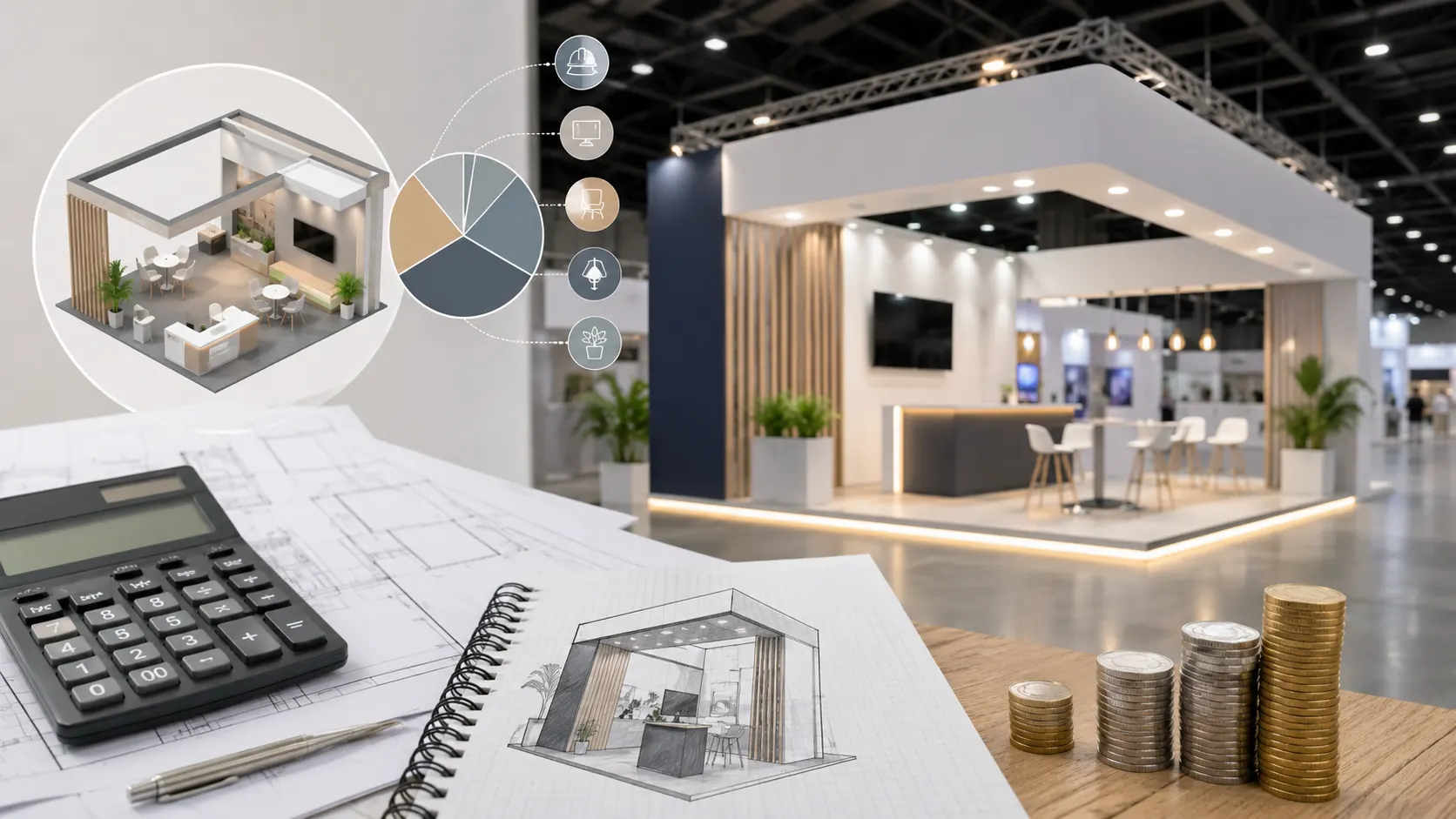
Booth pricing depends on more than square footage
Asking how much it costs to build a trade show booth may seem straightforward, but there is no universal rate that can accurately apply to every project. Two 430 sq. ft. booths can have very different budgets depending on their design, height, materials, location, level of customization, technology, destination city, and installation requirements.
It is also important to distinguish between exhibit space rental, booth construction, and the total cost of exhibiting. These concepts are related, but they are not the same.
At some events, the booth space fee includes only the raw exhibit area. Others offer packages that include walls, lighting, furniture, electricity, or even installation and cleaning. For this reason, comparing only a price per square foot can lead to misleading conclusions.
The most useful way to budget for trade show booth installation is to divide the project into categories: exhibit space, design, fabrication, graphics, technical services, logistics, installation, dismantling, and reuse. Then, the way these categories interact should be analyzed.
What the cost of a trade show booth really includes
Trade show booth cost (definition): the total resources required to design, produce, transport, install, operate, and dismantle an exhibit space in accordance with the requirements of the event.
To calculate the cost of exhibiting accurately, it is useful to separate three levels:
- Exhibit space cost: the floor space rented from the organizer.
- Booth cost: design, fabrication, graphics, equipment, transportation, and installation.
- Total exhibiting cost: the booth plus staff, travel, accommodations, marketing, samples, catering, and other related expenses.
This distinction is essential when comparing proposals. A €20,000 quote that includes transportation, installation, and graphics may be more comprehensive than a €15,000 quote that excludes all of those items.
A practical formula for calculating a trade show budget
A simple model can be expressed as follows:
Total cost = exhibit space + design and Project Management + fabrication + graphics + technical services + logistics + installation and dismantling + equipment + other event costs
This formula can also be applied at a more detailed level. For example, fabrication costs can be broken down into materials, production hours, finishes, testing, and packaging.
The advantage of this system is that it makes it easier to identify which variables are creating value and which are driving up the budget.
1. Booth size and location type
Square footage is one of the first cost factors, but it does not work in isolation. The booth configuration also matters.
A booth may be:
- Open on one side.
- Open on two sides or positioned on a corner.
- Open on three sides.
- Configured as an island with four open sides.
A booth with more open sides may have a higher floor-space rental rate and may also require more architectural treatment because some of the shared perimeter walls that would naturally exist in another configuration are no longer present.
As an example of how much rates can vary, the early-booking prices published by Messe Frankfurt for Ambiente 2027 start at €283 per m² for certain booth spaces open on one side and reach €360 per m² for spaces open on four sides, before additional fees. These figures refer to exhibit space rental for that specific event, not to the general cost of building a booth.
2. Design and Project Management
A custom project requires substantial work before fabrication begins.
This phase may include:
- Briefing.
- Creative concept.
- Space planning.
- 3D modeling.
- Technical drawings.
- Component breakdowns.
- Review of event regulations.
- Vendor coordination.
- Change management.
- Installation planning.
The greater the complexity, the greater the need for coordination. A booth with meeting areas, storage, audiovisual systems, elevated structures, and heavy products requires more technical development than an open booth with graphics and standard furniture.
Reducing this phase simply to lower the budget can have the opposite effect by creating late changes, incompatibilities, and additional labor during installation.
3. Materials and level of customization
Trade show booth fabrication may use wood and wood-based products, aluminum, textiles, panels, acrylic, metal, glass, and other materials.
The cost depends on:
- Quantity of material.
- Type and thickness.
- Machining complexity.
- Finishes.
- Painting.
- Special connections.
- Need for one-of-a-kind components.
A standard straight wall requires fewer production steps than a curved structure, a custom-designed piece of furniture, or a finish with complex geometry.
The right question is not simply which material is cheaper, but which solution fulfills the required function at the lowest total cost.
4. Signage and graphic printing
Graphics can represent a significant portion of the budget when the booth includes large customized surfaces.
Common solutions include:
- Printed vinyl graphics.
- Cut vinyl lettering.
- Fabric graphics.
- Printed rigid panels.
- Dimensional lettering.
- Lightboxes.
- Backlit elements.
The price depends on size, substrate, printing technology, finish, cutting, sewing or finishing, and installation.
Reuse also changes the calculation. A graphic structure designed to accept interchangeable fabric graphics may require a higher initial investment, but it can allow the frame to remain in use while only the campaign graphics are replaced for future trade shows.
5. Lighting, electricity, and venue services
One of the most common mistakes is assuming that all technical services are included in booth construction.
Depending on the event, the following may need to be ordered separately:
- Electrical service.
- Electrical distribution panels.
- Power consumption.
- Internet.
- Water and drainage.
- Compressed air.
- Rigging.
- Cleaning.
- Waste management.
- Material-handling equipment for loading and unloading.
Fira Barcelona states in its technical regulations that, as a general rule, the contracted space includes only the exhibit area unless the specific event expressly indicates that booth construction is included. The venue also offers dedicated logistics, utility, cleaning, furniture, audiovisual, and installation services.
Before comparing proposals, it is therefore essential to confirm which services are provided by the booth builder and which must be contracted directly through the event organizer.
6. Audiovisual systems and technology
LED walls, monitors, interactive systems, sound equipment, sensors, and demonstration devices increase the technical scope of the project.
The budget should not include only the device itself. Additional requirements may include:
- Support structures.
- Reinforcements.
- Cabling.
- Electrical power.
- Media players.
- Installation.
- Configuration.
- Technical support.
Technology adds value when it serves a clear purpose. Installing a large screen without useful content may increase the budget without improving commercial effectiveness.
7. Transportation and logistics
The city where the trade show takes place directly affects the cost.
Logistics may include:
- Packaging.
- Trucking.
- Tolls.
- Loading and unloading.
- Temporary storage.
- Material handling inside the venue.
- Return transportation of materials.
A booth transported from Barcelona to Paris, Frankfurt, or Milan will have a different logistics structure than one installed close to the production facility.
Design can help reduce this impact. Demountable, stackable components optimized for transportation can make more efficient use of freight volume.
8. Installation and dismantling labor
Trade show booth installation depends on the number of workers, the hours required, and the specialties involved.
Costs increase when there are:
- Highly complex installations.
- Very short setup windows.
- Night or overtime work.
- Very tall elements.
- Special structures.
- Extensive on-site finishing work.
Dismantling must also be included in the budget. A trade show does not end when the last visitor leaves: graphics must be removed, structures dismantled, materials sorted, trucks loaded, and the exhibit space returned in the condition required by the organizer.
9. Double-deck booths and special structures
Two-story booths can significantly increase the project budget. They require additional structure, stairs, guardrails, engineering calculations, and inspections.
Official Messe Frankfurt pricing provides a useful example. For certain shows, two-story construction carries a specific fee based on the covered area of the upper level and may also involve additional costs for structural inspections and fire protection requirements.
For 2026, Messe Frankfurt publishes, for example, a €1,495 fee for certain on-site inspections of two-story structures, along with specific charges for other constructions requiring structural review.
These figures do not represent the cost of fabricating a double-deck structure. They demonstrate that architectural complexity can also generate external regulatory costs.
10. Furniture, hospitality, and equipment
Tables, chairs, counters, display cases, refrigerators, coffee machines, plants, catering, and hospitality elements can be purchased, custom fabricated, or rented.
The decision should consider frequency of use and logistics. Custom furniture can strengthen brand identity, while renting standard pieces may be more efficient for certain international projects.
How much can booth pricing really vary?
Official trade show packages illustrate why there is no single answer.
For Ambiente, Messe Frankfurt currently publishes complete 12 m² packages starting at €6,535 and 16 m² packages starting at €8,125, including exhibit space, basic booth construction, furniture, electricity, cleaning, and selected services.
For Light + Building 2026, another official 16 m² package was published at €8,800 plus VAT, also including exhibit space, booth construction, and a defined equipment package.
These figures are useful as references for standardized packages, but they cannot be extrapolated to the cost of a custom-designed booth. A project featuring custom architecture, significant height, audiovisual systems, advanced graphics, or one-off fabrication will have a different cost structure.
Modular booth or custom booth: which costs less?
There is no universal answer.
Modular booth
It can spread the investment across multiple events by reusing the structure and replacing selected graphic or functional elements.
Fully custom booth
It offers greater freedom to respond to a specific footprint and concept, but it may require more custom fabrication.
Hybrid system
It combines a reusable structure with custom elements. For companies that exhibit regularly, it can offer an attractive balance between differentiation and cost per use.
How to compare two trade show booth proposals correctly
Do not compare only the total price. Confirm whether both proposals include the same items:
- Design and technical drawings.
- Project Management.
- Fabrication.
- Graphics.
- Lighting.
- Furniture.
- Transportation.
- Installation and dismantling.
- Travel and per diem expenses.
- Venue services.
- Post-show storage.
It is also important to confirm which elements will be owned by the client, which are rented, and which can be reused.
How to reduce costs without compromising the result
Reducing the budget does not necessarily mean reducing quality. The best opportunities are often found in the way the system is designed.
- Plan early: avoid rush fees and late changes.
- Prioritize: invest more in the areas that are truly visible.
- Use modular systems: reuse structures across multiple events.
- Standardize: reduce special components that do not serve a strategic purpose.
- Optimize transportation: design compact components.
- Update graphics: keep the structure and change the messaging.
- Centralize coordination: reduce incompatibilities between vendors.
The goal should be to reduce the total cost per use, not simply to achieve the lowest initial fabrication price.
How Full-Expo helps control the budget of a trade show booth
Full-Expo works exclusively with agencies and B2B professionals and provides fabrication, production, and trade show booth installation for projects across Europe.
Its operating model integrates multiple areas within the same workflow:
- Project Management.
- Trade show booth fabrication.
- Carpentry and painting.
- Signage and graphic printing.
- Installation.
- Logistics.
- Storage.
Full-Expo states that it has 2,000 m² of production and storage facilities approximately 250 meters from Fira Barcelona, along with ERP-CAD/CAM processes designed to connect project management and fabrication.
Centralizing these phases makes it possible to analyze the budget as a whole and identify opportunities for optimization during the design stage, rather than trying to cut costs once the project is already in production.
Conclusion: the cost of a trade show booth depends on what it needs to accomplish
The price of trade show booths depends on floor space, design, materials, graphics, technology, logistics, technical services, and installation complexity. For this reason, an isolated price per square foot rarely provides enough information.
The right way to build a budget is to first define what the booth needs to accomplish, translate those objectives into technical requirements, and then calculate each category of the project.
It is also useful to distinguish between initial investment and cost per use. A reusable solution may cost more for the first installation but become more efficient after several trade shows.
Strong Project Management helps control these relationships from the initial briefing through dismantling. Full-Expo can coordinate fabrication, graphics, logistics, and installation to build a budget around the actual project and help prevent costs from appearing only when there is little time left to respond.
Frequently asked questions about trade show booth costs and installation (FAQs)
There is no universal price per square foot. The cost depends on the event, design, materials, height, services, logistics, level of customization, and what is included in the proposal.
Not necessarily. At many events, the rental fee covers only the exhibit space, while others offer packages that include basic booth construction and equipment.
Extensive customization, special structures, double-deck booths, advanced technology, complex finishes, long-distance transportation, and short installation windows can all increase the cost.
It depends on the number of events and the level of customization. Rental can be efficient for one-time use, while a reusable structure can lower the cost per event when a company has a recurring trade show schedule.
The cost depends on labor hours, crew size, city, complexity, venue working hours, and the specialties required.
They may include electricity, internet, water, cleaning, rigging, material handling, parking, security, and other event-specific services.
Provide the floor plan, dimensions, event, dates, objectives, functional requirements, brand guidelines, equipment needs, required technology, and visual references.
Designing a modular structure, reusing components, updating only the graphics, and optimizing packaging, transportation, and storage can reduce the total cost over multiple events.