- What It Means to Choose the Right Signage for an Event
- Decision Framework: How to Evaluate a Signage Solution
- Comparative Ranking: The Best Types of Event Signage
- Quick Comparison by Objective
- How to Choose Based on Event Type
- Common Mistakes When Selecting Event Signage
- Conclusion: The Best Signage Is the One That Achieves the Goal Efficiently
- Frequently Asked Questions (FAQs)
What It Means to Choose the Right Signage for an Event
Event signage at trade shows and professional exhibitions is not a decorative element. It is a communication system that directly impacts visibility, brand perception, and a booth’s ability to turn traffic into meaningful conversations. Choosing the best types of event signage requires both technical and commercial judgment: what you need to communicate, to whom, in how much time, and under which space, regulatory, and budget constraints.
On a busy trade show floor, attention is limited. Attendees usually decide within seconds whether to approach a booth. In that short window, your signage must answer three essential questions: who you are, what you offer, and why it matters. Effective signage is therefore clear, well-structured, and fully aligned with your visual identity.
This guide compares the main types of event signage and explains which solutions perform best depending on the type of event and your objectives. It also provides a practical framework to help you choose the most cost-effective option and avoid common mistakes.
Decision Framework: How to Evaluate a Signage Solution
To compare signage solutions objectively, use consistent evaluation criteria. The best types of event signage stand out based on how they balance the following variables:
- Distance visibility: ability to stand out from aisles and entrances.
- Readability: clear messaging under varying lighting conditions and viewing angles.
- Durability: resistance to installation, heavy use, dismantling, and transportation.
- Reusability: potential to use the same signage across multiple events.
- Total cost: production, installation, logistics, maintenance, and replacement.
- Compatibility: adaptability to walls, frames, structures, and specialty surfaces.
- Installation time: impact on labor and venue-related operational costs.
With this framework, decisions move beyond aesthetics and focus on real-world performance.
Comparative Ranking: The Best Types of Event Signage
1) Printed Vinyl and Cut Vinyl Graphics
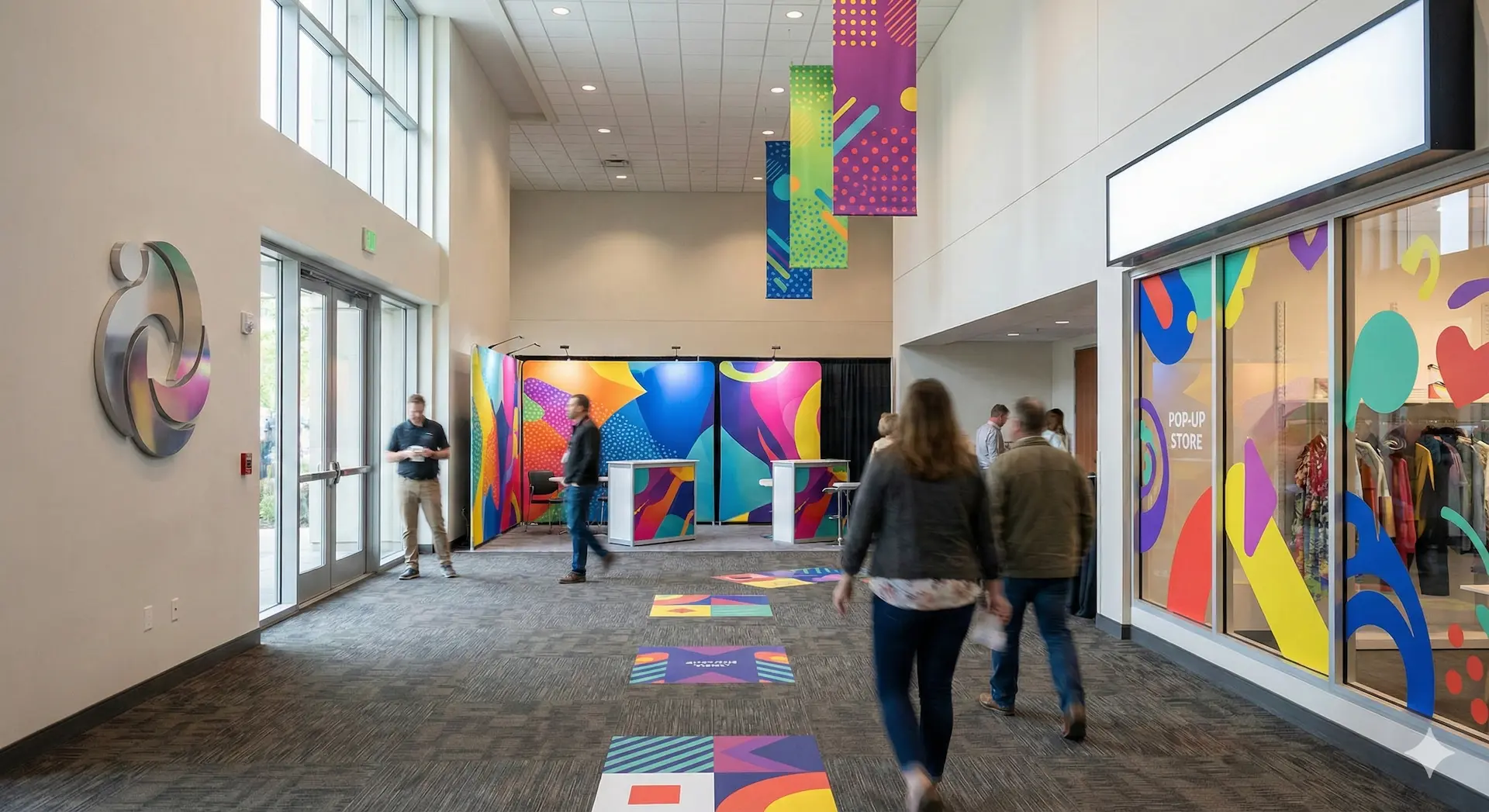
Vinyl graphics are among the most widely used solutions in trade show signage. They can be applied to walls, glass, counters, floors, and other flat surfaces. Their versatility makes them a popular choice for many event environments.
When to Choose Vinyl
- Short-term events or limited-time campaigns.
- Booths with flat surfaces requiring quick message updates.
- Promotional activations with bold, large-scale graphics.
Advantages
- High-resolution printing and a wide range of finishes.
- Cost-effective for large surface coverage.
- Fast customization and production.
Limitations
- Limited reusability if messaging is highly specific.
- Certain finishes may create glare under strong lighting.
2) Large-Format Fabric Graphics
Fabric signage is printed on technical textiles and used for backdrops, graphic walls, and tension systems. Its popularity in the U.S. trade show market continues to grow due to its aesthetic quality and logistical efficiency.
When It Stands Out
- International events where shipping and storage matter.
- Booths seeking a seamless, high-end finish.
- Projects requiring graphic updates across editions.
Advantages
- Smooth, seamless appearance.
- Lightweight and easy to transport.
- Minimal glare and strong readability in complex lighting conditions.
Limitations
- Requires precise framing systems for proper tensioning.
- Production quality must be carefully controlled to avoid distortion.
3) 3D Dimensional Lettering and Logos
Dimensional signage adds depth and volume to a logo or brand name. It is frequently used to reinforce premium positioning and create a strong physical presence on the show floor.
Best Use Cases
- Brands focused on visibility and recognition.
- Events with visually saturated environments.
- Booths with generous height and wide viewing angles.
Advantages
- High visual impact and fast brand recognition.
- Durable when manufactured with appropriate materials.
- Elevated perception of quality and professionalism.
Limitations
- Heavier components and added logistics.
- Requires proper mounting solutions in compliance with venue regulations.
4) LED Backlit Signage
Backlit signage integrates LED lighting into logos or graphic panels. At trade shows, it is one of the most effective solutions for standing out in wide aisles or uneven lighting conditions.
When It Is Highly Recommended
- Technology, industrial, or highly competitive trade shows.
- Booths that require long-distance visibility.
- Brands aiming to project innovation and modernity.
Advantages
- Superior visibility and enhanced logo clarity.
- Greater attraction compared to flat graphics.
- Strong association with cutting-edge branding.
Limitations
- Electrical planning and coordination with venue services required.
- Higher cost compared to non-illuminated solutions.
5) Integrated Wayfinding Signage
Wayfinding signage organizes the booth layout and improves visitor flow. Clear directional communication reduces friction and helps convert traffic into qualified engagement.
Where It Adds Value
- Booths with multiple zones: demos, meetings, reception, storage.
- High-traffic conventions and conferences.
- Complex product presentations requiring step-by-step guidance.
Advantages
- Improves visitor experience and reduces confusion.
- Increases dwell time within the booth.
- Reinforces a sense of organization and professionalism.
Limitations
- If poorly integrated, it may disrupt brand consistency.
6) Hanging Banners and Suspended Elements
Suspended signage solutions offer high visibility when venue regulations allow. They help attendees locate your booth from across large exhibition halls.
When to Use Them
- Booths located away from main aisles.
- Venues with sufficient ceiling height and supportive regulations.
Advantages
- Quick identification from multiple aisles.
- Potential for 360-degree visibility when properly designed.
Limitations
- Dependent on venue rules and approval processes.
- Additional rigging and installation costs.
7) Rigid Panels and Acrylic Signage
Acrylic and rigid panel signage deliver a clean, corporate finish. They are commonly used for directional signage, product listings, and understated brand elements.
Ideal For
- Formal corporate events and conferences.
- Booths seeking a refined, long-lasting aesthetic.
Advantages
- Elegant and durable finish.
- Strong readability for interior signage.
Limitations
- Less flexible when frequent message updates are required.
Quick Comparison by Objective
- Maximum visual impact: dimensional lettering and LED backlit signage.
- Best cost-visibility balance: printed and cut vinyl graphics.
- Best for international logistics: large-format fabric graphics.
- Best for organization and flow: integrated wayfinding signage.
- Best long-distance visibility: hanging banners and suspended elements.
- Best for formal environments: acrylic and rigid panel signage.
How to Choose Based on Event Type
Industrial and B2B Trade Shows
- Dominant logo using dimensional lettering or LED.
- Fabric graphics for clean, durable backdrops.
- Clear zoning with structured wayfinding.
Professional Conferences
- Institutional signage with concise messaging.
- Rigid panels for room identification and credentials.
- Low-glare graphics for variable lighting conditions.
Short-Term Promotional Events
- Printed vinyl for fast campaign rollouts.
- Easy-to-install and removable elements.
- Direct, activation-focused messaging.
Common Mistakes When Selecting Event Signage
- Choosing based solely on price rather than total cost.
- Failing to consider reuse for future events.
- Ignoring venue lighting and glare issues.
- Overloading graphics with excessive text.
- Not integrating signage and graphics into a unified visual system.
Conclusion: The Best Signage Is the One That Achieves the Goal Efficiently
The best types of event signage are not necessarily the most expensive or the most eye-catching. They are the ones that meet your booth objectives with clarity and consistency. A strong solution balances impact, readability, durability, and total cost—turning signage into a true brand and sales performance asset.
If you want to maximize your trade show presence, signage should be designed as part of the overall booth system: messaging, visitor flow, touchpoints, and experience. That integration is what ultimately drives measurable results.
Frequently Asked Questions (FAQs)
The most effective solution combines a clear primary message with strong visibility—typically dimensional lettering, LED backlit signage, or hanging banners, depending on venue regulations and booth location.
Printed vinyl with well-structured graphics is often the most cost-effective choice, maximizing both surface area and budget efficiency.
Large-format fabric graphics are often preferred due to their lightweight structure, easy transport, and seamless finish across expansive surfaces.
Vinyl is more versatile for diverse surfaces and short-term campaigns. Fabric is ideal for seamless backdrops, reduced glare, and improved reusability.
Message hierarchy, color contrast, long-distance readability, and proper illumination of the primary logo are the most decisive elements.