
- Why signage evolves faster than the booth itself
- 1. Clear graphics and extreme visual hierarchy
- 2. Signage designed around visitor flow
- 3. Strategic use of integrated lighting in signage
- 4. Printed textiles as the visual standard
- 5. Sustainable and reusable materials
- 6. Extreme customization without higher costs
- 7. Integration of functional wayfinding and branding
- 8. Signage designed for reuse across multiple events
- 9. Reduced glare and improved readability
- 10. Signage designed to generate digital content
- How to apply these trends without losing coherence
- Closing: signage as a competitive advantage at trade shows
- Frequently asked questions about trade show signage trends (FAQs)
Why signage evolves faster than the booth itself
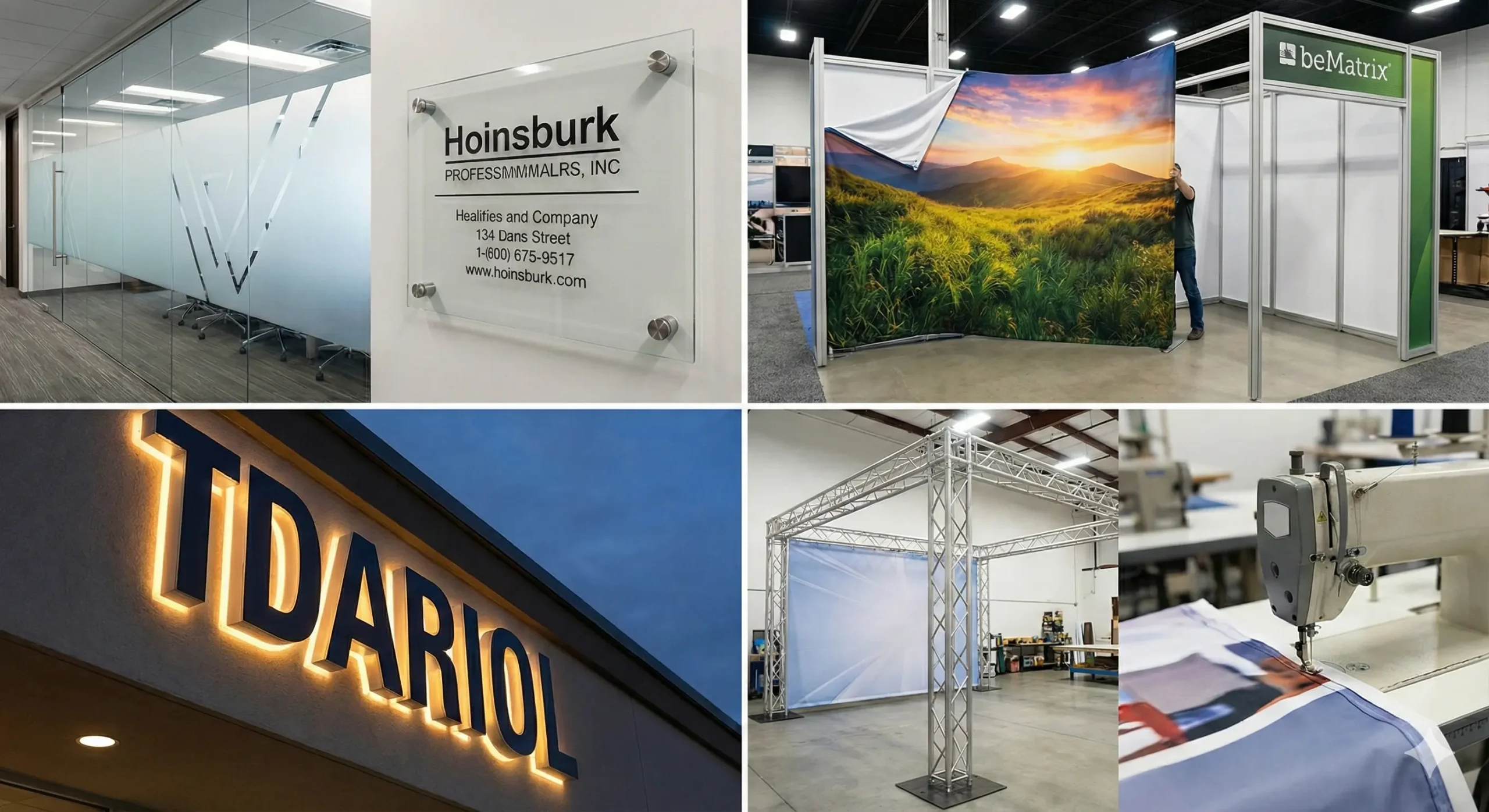
Signage is one of the fastest-evolving elements within the trade show ecosystem. While booth structures are often designed to last for several years, graphics, materials, and wayfinding systems change in response to technology, sustainability requirements, and evolving attendee expectations. At professional trade shows, signage plays a critical role: capturing attention, communicating value, and guiding the visitor experience. In 2026, this role becomes even more important due to three clear factors: increased visual saturation, more informed attendees, and growing pressure to justify return on investment. Signage trends are not driven by isolated aesthetic fashions, but by operational, commercial, and environmental needs. This article outlines the ten key trends shaping professional trade show and event signage in 2026, with a practical, application-focused approach.
1. Clear graphics and extreme visual hierarchy
The first major trend is strategic message simplification. In environments where visitors decide in seconds, signage is moving toward eliminating visual noise and prioritizing a single, clear message.
- One primary message visible from a distance
- Secondary text only in interaction zones
- Intentional use of white space
This trend is supported by trade show behavior studies showing that booths with simple, well-structured messaging achieve higher approach rates than those overloaded with information.
2. Signage designed around visitor flow
Signage is no longer purely decorative—it is increasingly designed as a navigation tool. In 2026, visitor-guided signage becomes a standard.
- Clear entry and exit indicators
- Functional zone markers
- Sequential messaging aligned with visitor movement
This approach improves user experience and reduces friction in high-traffic booths.
3. Strategic use of integrated lighting in signage
Lighting is no longer an add-on; it is built directly into graphic elements. Dimensional letters, logos, and backlit panels gain prominence.
- Improved visibility in poorly lit halls
- Stronger brand recognition
- Visual contrast versus neighboring booths
At European trade shows, integrated illuminated signage is strongly associated with a more professional and technology-driven brand perception.
4. Printed textiles as the visual standard
Printed textiles continue to establish themselves as one of the most widely used signage media at trade shows in 2026. Their seamless finish and lightweight nature make them highly efficient.
- Large graphic surfaces without visible seams
- Easy transport and storage
- Fast, precise installation
Textiles also allow better color control and reduce common issues such as bubbles or glare.
5. Sustainable and reusable materials
Sustainability is no longer a nice-to-have—it is a requirement. In signage, this translates into materials designed for multiple uses and reduced environmental impact.
- Reusable textile graphics
- Lower-impact vinyl solutions
- Reduced use of single-use materials
At many European events, exhibitors using reusable signage improve brand perception while lowering mid-term event costs.
6. Extreme customization without higher costs
Thanks to advances in digital printing, customization is no longer a premium option. In 2026, there is a clear rise in graphics tailored to specific markets, languages, or campaigns.
- Country- or region-specific messaging
- Adaptation to defined audience segments
- Short runs without cost penalties
This trend allows brands to be more relevant without inflating budgets.
7. Integration of functional wayfinding and branding
Wayfinding is no longer designed separately. In 2026, functional signage is visually integrated into the main booth graphics.
- Directional signs aligned with brand identity
- Functional information without breaking visual consistency
- Improved spatial understanding
This integration enhances visitor experience and reinforces a sense of order and professionalism.
8. Signage designed for reuse across multiple events
More brands now require signage that can adapt to different trade shows. This drives flexible, modular, and scalable design.
- Interchangeable graphics
- Timeless visual elements
- Easily updatable messaging
This trend has a direct impact on booth profitability and annual event budget optimization.
9. Reduced glare and improved readability
Matte finishes and anti-glare materials become a priority. In halls with complex lighting conditions, readability is critical.
- Text legible from multiple angles
- Improved visual comfort
- Reduced eye fatigue for visitors
This trend is supported by visual perception research applied to commercial environments.
10. Signage designed to generate digital content
Signage is increasingly designed to be photographed and shared. In 2026, booths are planned with social media and digital exposure in mind.
- Backdrops optimized for photos and video
- Camera-readable messaging
- Visual consistency across digital content
This extends the booth’s reach beyond the exhibition hall.
How to apply these trends without losing coherence
Adopting trends does not mean applying all of them. The key criterion is alignment with booth objectives and brand identity.
- Prioritize visibility and clarity
- Select materials based on real use
- Design with reuse in mind
- Integrate graphics, wayfinding, and lighting
Effective signage in 2026 will combine visual impact, operational efficiency, and profitability.
Closing: signage as a competitive advantage at trade shows
Trade show signage trends for 2026 reflect a clear evolution toward smarter, more sustainable, and results-driven systems. Signage is no longer about decorating a booth—it is about building an effective communication tool that performs in seconds and across multiple contexts. Brands that understand this shift will stand out in increasingly competitive environments, optimize their event investment, and enhance the visitor experience.
Frequently asked questions about trade show signage trends (FAQs)
Message simplification, printed textiles, integrated lighting, sustainability, and reusable signage are among the most significant trends.
Because it offers a seamless finish, easy transport, fast installation, and excellent color management on large surfaces.
It directly impacts visibility, brand recall, and the quality of interactions with visitors.
Yes, many trends focus on optimization, reuse, and process improvement rather than higher costs.
Applying trends without strategy, overloading the booth, and losing coherence with brand identity and commercial objectives.