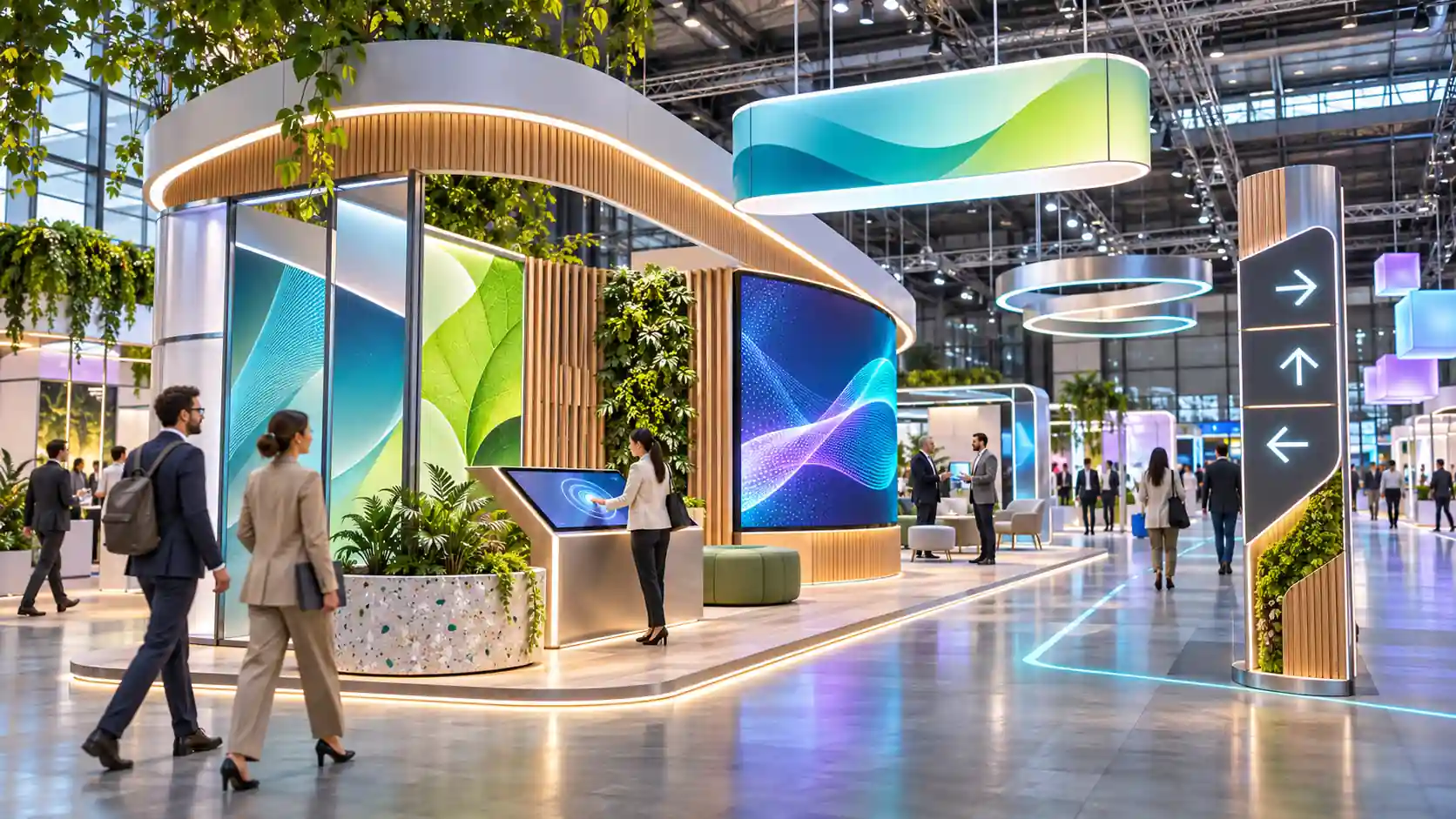
Trade show signage in 2027 will combine physical signage, lighting, interchangeable graphics, and digital communication. The priority will be integrating these elements into the overall booth design.
For agencies, the goal will not be to incorporate every available technology, but to select solutions that improve brand recognition, readability, wayfinding, and execution.
Trade show signage: the combination of graphic, three-dimensional, illuminated, and wayfinding elements used to communicate and identify a brand at trade shows and conferences.
Professional signage: the technical development of these elements, taking into account design, materials, dimensions, fabrication, installation, safety, and maintenance.
The main trends for 2027 include architectural integration, dimensional lettering, LED lighting, modular fabric graphics, and the combination of physical and digital signage.
These technologies are already available in the industry. Their development throughout 2027 should be understood as an informed forecast, not as evidence of universal adoption.
Decisions should follow four criteria: function, visibility, technical feasibility, and total cost per use.
Eight trade show signage trends for booths in 2027
The industry already offers solutions that integrate physical and digital communication. FESPA highlights the convergence of both approaches and the growing integration of signage into architectural environments.
European Sign Expo 2027 is scheduled for April 6-9 in Munich, featuring technologies such as dimensional lettering, illuminated signage, digital signage, and architectural applications.
These references indicate which technologies are actively used in the industry, but they do not establish what percentage of booths will adopt them during 2027.
1. Signage integrated into booth architecture.
Architectural signage: a visual communication system incorporated into the structural design of walls, facades, three-dimensional elements, and furniture.
The logo is no longer an element added at the end of the project. Its support, depth, lighting, and placement are addressed during technical development.
This integration is useful when the brand needs to be visible from main aisles or become part of the booth’s facade.
- Application: facades, entrances, reception counters, and main walls.
- Potential benefit: consistency between corporate identity and booth construction.
- Limitation: may increase the complexity of component breakdowns and installation.
- Validation: verify mounting systems, dimensions, and maintenance access.
In 2027, designing booth architecture and graphics using the same technical documentation will be particularly relevant to preventing incompatibilities between suppliers.
2. Dimensional lettering and integrated LED lighting.
Dimensional signage: three-dimensional elements that reproduce letters, symbols, or logos using components with physical depth.
Backlit signage: a system in which a light source positioned behind the visible surface produces controlled illumination.
Dimensional lettering can incorporate front, rear, or side illumination. The choice depends on the desired visual effect and construction requirements.
It is important to distinguish illuminated signage from an LED display. The former uses light to highlight a physical brand identity, while the latter displays changing digital content.
- Non-illuminated dimensional lettering: three-dimensional brand identification through depth and finish.
- Illuminated dimensional lettering: physical signage with an integrated light source.
- Lightbox: a graphic surface illuminated from within.
- LED display: an electronic device used to present dynamic digital content.
Illuminated solutions require an electrical power supply, thermal management when applicable, and access for potential repairs.
Lighting should enhance contrast. An excessively bright surface can reduce readability or create distracting reflections.
3. Tensioned fabric graphics and modular surfaces.
Tensioned fabric graphics: printed fabric installed using profiles or tensioning systems to create a continuous graphic surface.
They can be used for branded backdrops, walls, lightboxes, and structures intended for multiple trade shows.
Their operational value lies in the ability to separate the supporting structure from the graphic content when the system is designed for that purpose.
An agency can retain certain frames and replace the fabric graphics when a campaign changes.
- Application: graphic walls, backdrops, and modular systems.
- Potential benefit: updating messaging without replacing the entire structure.
- Limitation: the final result depends on fabric tension, dimensions, and storage conditions.
- Validation: check profiles, finishes, seams, and final dimensions.
Actual reuse depends on the number of uses, the condition of the materials, and compatibility with different booth spaces.
Using fabric does not automatically demonstrate a reduction in environmental impact compared with other substrates.
4. Hybrid signage: printed graphics and digital displays.
Hybrid signage: a system combining printed or physical elements with digital content as part of a unified communication strategy.
Fixed signage can identify the brand. A digital display can explain products, show demonstrations, or update information throughout the event.
QR codes can also connect printed signage with catalogs, technical specifications, or online content.
FESPA identifies the convergence of physical and digital media as a relevant development in visual communication environments.
- Static graphics: permanent messaging and brand recognition.
- Digital display: demonstrations and updatable content.
- QR code: access to additional information.
- Wayfinding signage: identification of spaces and visitor routes.
Each element should serve a clear purpose. A screen without useful content may add cost, electricity consumption, and maintenance requirements.
5. Functional wayfinding signage and accessible design.
Trade show wayfinding signage: visual elements that identify areas and help visitors navigate within a booth.
Visual hierarchy: the organization of messages according to their importance to facilitate recognition and readability.
The brand, primary value proposition, functional areas, and calls to action should not all compete for the same level of attention.
In booths with multiple areas, signage can distinguish reception, meeting spaces, demonstration areas, and product displays.
- Identification: clearly display the brand.
- Wayfinding: indicate entrances and interior areas.
- Information: explain products or activities.
- Action: show visitors where to request a demonstration or meeting.
Readability should be evaluated from actual viewing distances and approach angles, not only by looking at the design on a screen.
Contrast, reflections, installation height, and applicable accessibility requirements should also be reviewed.
6. Customized graphics for international trade show tours.
Modular signage: a system whose components can be combined, dismantled, or replaced to accommodate different exhibit configurations.
A brand exhibiting in Madrid, Barcelona, and Munich can retain its primary structure while updating selected messages.
Adaptations may involve language, displayed products, campaigns, booth dimensions, or organizer requirements.
To manage this customization effectively, permanent elements should be separated from those that will need to change.
- Permanent: logos, structures, and certain supporting elements.
- Variable: campaigns, messages, languages, and images.
- Site-dependent: dimensions, heights, mounting systems, and layout.
- Subject to review: components that are damaged or incompatible with the next event.
The forecast for 2027 is that this flexibility will remain relevant for agencies managing international trade show calendars and recurring projects.
7. Large-format printing with color management and digital production.
Large-format printing: production of oversized graphics on materials such as vinyl, fabric, or rigid substrates.
Color management: a set of procedures used to control color reproduction across files, devices, and materials.
ICC profiles describe color characteristics and enable controlled conversions between color spaces and devices.
However, they do not guarantee that fabric, vinyl, and backlit surfaces will produce exactly the same visual result.
Color reproduction also depends on the substrate, ink, lighting, and printing conditions.
For an agency, digital quality control should include:
- Clearly identified final artwork files.
- Verified scales and dimensions.
- Approved graphic panel breakdowns.
- Color profiles appropriate for the production workflow.
- Proofs when accurate corporate colors are critical.
- Matching each graphic to its corresponding installation component.
Traceability between the technical team, printing department, and installation crew can reduce dimensional and version-related errors.
8. Reusable signage with documented results.
Signage reuse: using the same supporting structure or component at different events while preserving its intended function.
Cost per use: the cumulative cost attributable to an element divided by the actual number of times it has been used.
In 2027, it will remain reasonable to prioritize demountable designs, interchangeable graphics, and repairable components.
However, a reusable solution does not necessarily have a lower environmental impact if it requires additional transportation, frequent repairs, or significant component replacements.
Evaluation should consider verifiable data:
- Number of reused components.
- Cumulative events per component.
- Square meters of newly produced graphics.
- Materials replaced or repaired.
- Actual waste generated.
- Cumulative system cost.
Stating that a sign has been used at four trade shows is a verifiable claim. Attributing an emissions reduction to that reuse requires a specific calculation.
How to select and produce trade show signage with a B2B technical partner
Trends create value when they become solutions suited to the event, brand, and budget.
For an agency, the selection process should begin with the purpose of the message and continue with technical validation.
Trade show signage selection: the process of choosing materials and systems according to communication objectives, placement, restrictions, and available resources.
A simple decision matrix can help identify the most appropriate solution:
- Identify the brand: dimensional logos, main graphics, or lightboxes.
- Communicate a campaign: printing on fabric, vinyl, or rigid panels.
- Update information: digital displays or dynamic content.
- Guide visitors: clear wayfinding signage.
- Adapt a trade show tour: modular structures and interchangeable graphics.
- Highlight details: integrated lighting or three-dimensional finishes.
The selection must be validated against actual technical drawings. Signage cannot be evaluated solely on its appearance in a rendering.
Technical validation of signage: verification of dimensions, materials, mounting systems, lighting, and installation conditions before fabrication.
A recommended process for agencies includes six steps:
- 1. Define: establish the brand, key messages, and priority audience.
- 2. Prioritize: organize information according to its purpose.
- 3. Select: choose physical, illuminated, or digital signage solutions.
- 4. Validate: review drawings, mounting systems, services, and regulations.
- 5. Fabricate: verify artwork, materials, finishes, and components.
- 6. Verify: check readability, installation, and functionality in the finished booth.
Graphics should be coordinated with the structure and technical installations from the beginning. This is especially important for dimensional signage, lightboxes, and digital displays.
The position of a display can affect structural reinforcements, cabling, and ventilation. A lightbox may determine the required wall depth.
For a trade show tour, packing, storage, and graphic replacement procedures should also be defined.
How Full-Expo can support agencies.
At Full-Expo, we work exclusively with agencies and B2B professionals, integrating trade show booth fabrication, production, and installation for events across Europe.
We provide booth signage, large-format digital printing, vinyl graphics, dimensional signage, lightboxes, and custom wayfinding solutions.
We also operate with digitalized ERP-CAD/CAM processes and have dedicated carpentry, assembly, painting, and logistics areas.
Our approximately 2,000 m² production and storage facilities allow us to coordinate different disciplines within the same project.
For agencies, the advantage is being able to approach signage and booth construction as a coordinated process rather than treating them as disconnected services.
This coordination can help streamline dimensional checks, change management, finish quality control, and installation preparation.
It does not mean that every technology is necessary or that all systems can be reused indefinitely.
The goal is to choose the right solution for each message and execute it according to the event’s technical requirements and budget.
The trade show signage trends for 2027 therefore point toward greater integration between architecture, physical communication, digital content, and manufacturing processes.
Implementation should always follow the same principle: define the function, select the substrate or system, validate technical feasibility, and verify the final result.
Frequently asked questions about trade show signage in 2027 (FAQs)
They should be submitted before the production deadline agreed upon with the manufacturer, allowing enough time to review file formats, dimensions, colors, printing requirements, and potential corrections.
No. The venue’s regulations, permitted materials, slip resistance, and removal requirements must be checked to ensure the flooring is not damaged.
Depending on the event, suspended signage may require prior authorization, structural documentation, and the booking of suspension points or rigging services.
Through packaging suited to the substrate, clear component identification, and protection against moisture, abrasion, deformation, and improper handling.
In some cases, yes. The structure, finish, mounting systems, and lighting components should be inspected before reinstallation.
It is advisable to have a designated technical contact, access to the equipment, and an alternative message ready. The solution depends on the type of failure and the venue’s authorized intervention procedures.