
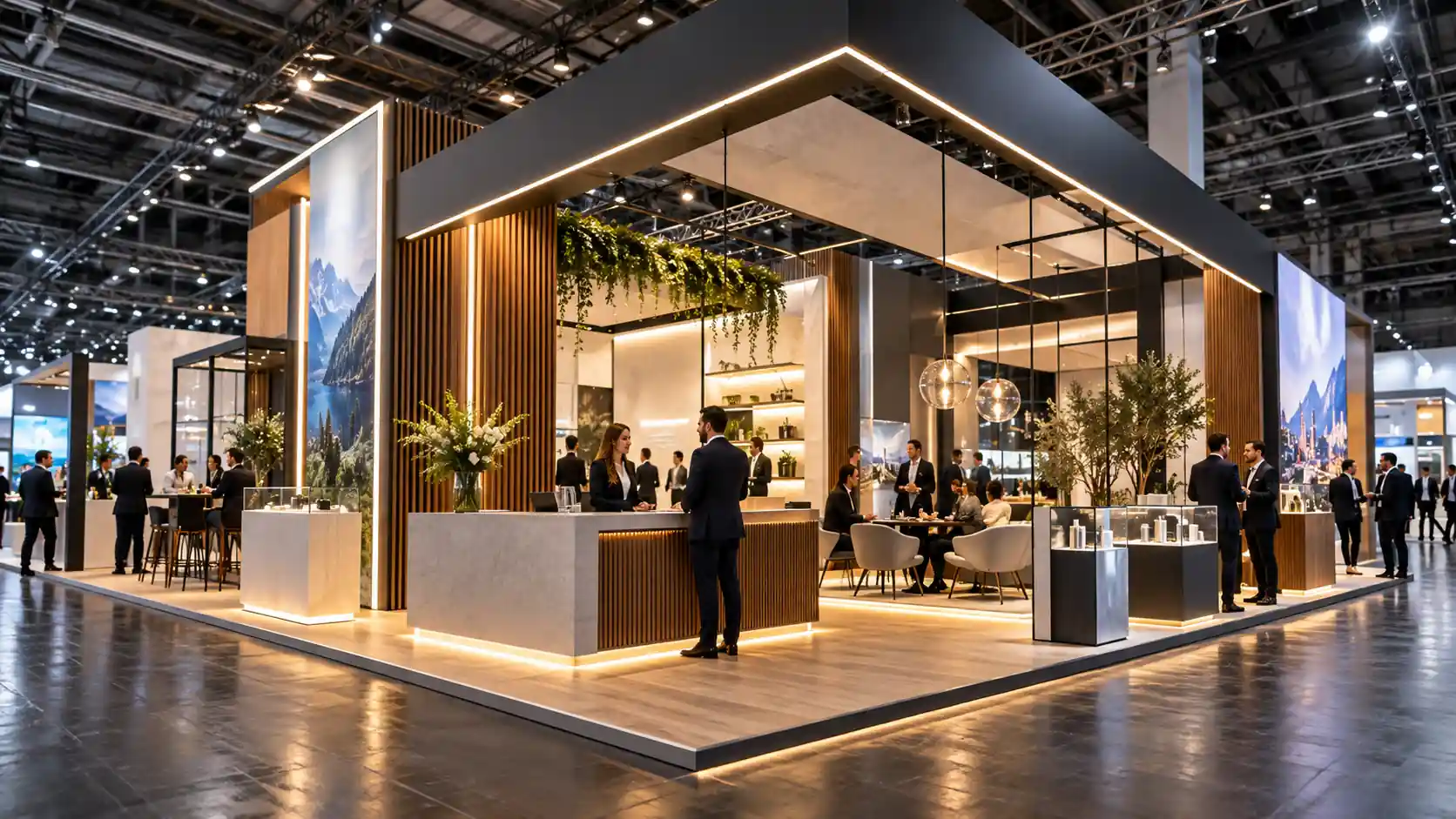
What a B2B booth manufacturer is and why it matters
Executing a professional trade show booth requires connecting design, engineering, fabrication, graphics, logistics, and installation within a schedule that ends on an almost immovable date: the opening of the trade show.
For agencies, architecture firms, and event professionals, maintaining in-house industrial capabilities for every one of these phases is not always practical. This is why a specialized agency-manufacturer partnership model exists.
B2B trade show booth manufacturer: a company specialized in transforming exhibit concepts into solutions that can be fabricated and installed, working as an industrial supplier for agencies and industry professionals.
Trade show booth production for agencies: a model in which the agency retains responsibility for strategy, creativity, and the commercial relationship, while the manufacturer handles the agreed technical, production, and logistics tasks.
This model creates a clear division of responsibilities. The agency leads the client-facing proposal, while the manufacturer provides technical expertise, facilities, personnel, and execution capacity.
The distinction from a simple intermediary is important. A manufacturer participates directly in the physical execution of the project and can control critical processes before the materials ever reach the venue.
Advantages of working with a specialized B2B manufacturer
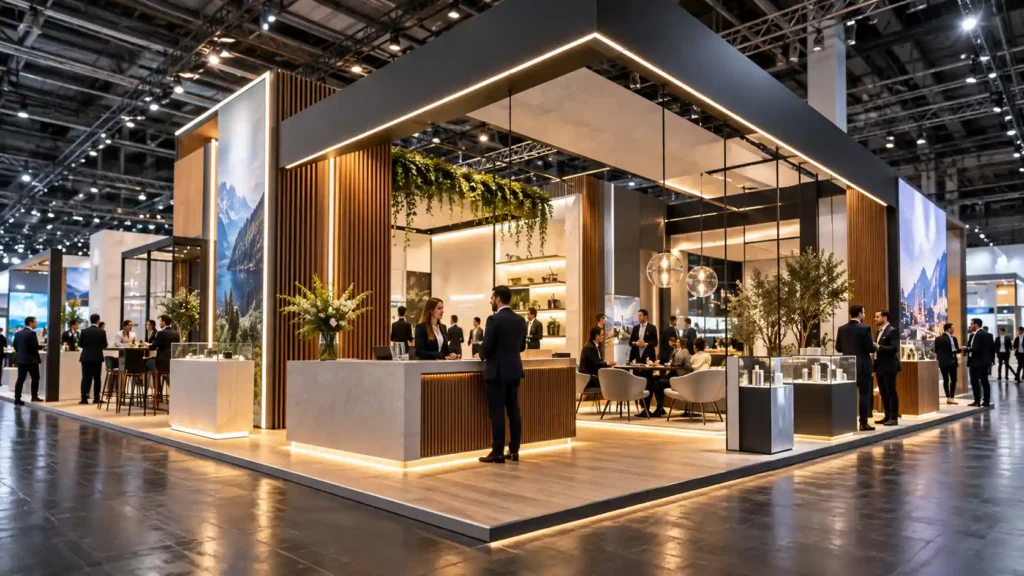
The main value does not come simply from having a workshop. It comes from combining industrial capacity with an operating structure designed to collaborate with other professionals.
- Production control: direct oversight of structures, furniture, finishes, and components.
- Technical feasibility: identification of potential incompatibilities before fabrication begins.
- Confidentiality: respect for the commercial relationship between the agency and the end client.
- Scalability: ability to handle different project sizes and multiple projects when capacity is available.
- Coordination: connection between production, graphics, transportation, and installation.
- Traceability: identification of components, versions, and project status.
- Reuse: ability to retain components for use across different events.
These advantages are interconnected. Early technical control helps ensure correct fabrication; organized production simplifies logistics; and well-planned logistics reduces issues during installation.
Trade show booth fabrication should therefore be understood as a chain of connected processes rather than as an isolated activity.
From creative design to a booth that can actually be built
A rendering shows how the space should look, but it does not necessarily contain all the information required to build it. Between design and fabrication lies an engineering phase that converts creative intent into executable instructions.
The technical review should analyze dimensions, materials, connections, stability, utilities, lighting, graphics, audiovisual systems, transportation, and installation sequence.
A validation process can follow five steps:
- 1. Review the space: dimensions, open sides, columns, heights, and utility connection points.
- 2. Review regulations: restrictions established by the organizer and venue.
- 3. Resolve the construction: materials, structures, connections, and finishes.
- 4. Integrate services: electricity, lighting, graphics, screens, and equipment.
- 5. Design the installation process: component breakdown, packaging, transportation, and installation order.
This process should not arbitrarily alter the creative concept. Its purpose is to identify the most appropriate technical solution for bringing that concept to life.
A complex geometry, for example, can be fabricated using different methods. The right solution depends on the desired finish, structural stability, workshop time, transportation, cost, and potential reuse.
Digitalization can improve this process when technical data remains connected. CAD helps define geometry; CAM can transfer information into certain fabrication processes; and an ERP system can centralize resources and project status.
The real value does not lie in the acronyms. It lies in preventing the design team, workshop, and installation crew from working with different versions of the same component.
Trade show booth production for agencies: control without losing the client relationship
An agency needs more than production capacity. It needs a supplier that understands how a B2B relationship works.
The agency may handle strategy, creativity, art direction, presentation, and the commercial relationship. The manufacturer develops the engineering, production, and execution according to the agreed scope.
This division of responsibilities should be defined from the initial briefing. Communication channels, approval responsibilities, and the change-management process should also be agreed in advance.
A strong trade show booth production model for agencies also protects the relationship with the end client. The manufacturer acts as the agency’s industrial extension rather than as a commercial competitor within the same project.
For recurring projects, this relationship can build accumulated knowledge. The manufacturer becomes familiar with the agency’s finish standards, construction systems, and operational preferences.
This can reduce repetitive decisions on future projects, although each booth must still be validated according to its specific space, regulations, and requirements.
Project Management, logistics, and installation at European trade shows
Fabrication ends in the workshop, but the project continues until the booth is installed and ready to receive visitors.
International projects add transportation, venue access requirements, official services, installation hours, documentation, and coordination with different venues.
A complete operational workflow can be organized as follows:
- Briefing: scope, schedule, budget, and responsibilities.
- Engineering: drawings, feasibility, and technical documentation.
- Production: fabrication, graphics, finishes, and testing.
- Logistics: inventory, packaging, loading, and transportation.
- Installation: layout, construction, technical installations, and finishes.
- Handover: technical, visual, and functional verification.
- Dismantling: removal, sorting, and return transportation.
Trade show booth Project Management: integrated coordination of scope, responsibilities, deadlines, and dependencies from project intake through final closeout after the event.
Its purpose is to reduce uncontrolled interfaces. If a screen changes position, for example, the change may affect carpentry, supports, electrical work, graphics, and audiovisual content.
Centralizing the change makes it possible to analyze all of those consequences before implementation.
Across Europe, each event may impose specific requirements. Working internationally therefore requires reviewing the documentation for each venue rather than automatically reusing the conditions from a previous trade show.
Reuse, total cost, and scalability
An agency managing several trade shows can achieve greater value when certain components are designed to last beyond a single event.
Structures, lighting, signage, furniture, or selected technical elements can be retained while graphics and layouts are adapted to each new booth space.
Total cost per use: the cumulative investment in fabrication, adaptation, transportation, installation, storage, and maintenance divided by the actual number of events in which the system is used.
This metric makes it easier to compare a temporary solution with one designed for repeated use.
Modularity also supports scalability. A system can be configured for different booth sizes if this flexibility is built into the original design.
However, reusable does not automatically mean sustainable or cost-effective. Transportation distance, maintenance, storage, repairs, actual number of uses, and the need to fabricate new components must all be considered.
The decision should be based on the agency’s actual event calendar rather than on a generic sustainability claim.
How to choose a trade show booth manufacturer for an agency
The selection should be based on demonstrated capability and operational compatibility. A competitive price loses value if the supplier cannot handle the required technical level or schedule.
- B2B model: does the manufacturer respect the relationship between the agency and the end client?
- Facilities: which processes are performed in-house?
- Capacity: can the manufacturer handle the required volume and schedule?
- Engineering: does the team review feasibility and develop technical documentation?
- Production: how are quality, versions, and finishes controlled?
- Europe: can the manufacturer organize logistics and installation in the required markets?
- Project Management: is there a clearly identified project lead?
- Graphic services: can printing, signage, and branded elements be integrated?
- Reuse: are there solutions for adapting and storing components?
- Budget: are scope, exclusions, and additional costs clearly defined?
It is also important to evaluate how the manufacturer responds when an issue arises. The ability to identify the problem, communicate it clearly, and propose a workable solution is especially important when the event opening date cannot be moved.
For agencies managing several projects simultaneously, available production capacity should also be verified. Experience across Europe alone does not prove that a manufacturer has the capacity to execute multiple concurrent installations.
How Full-Expo can support agencies as a B2B manufacturer
Full-Expo positions its business specifically around trade show booth fabrication for agencies and B2B professionals.
Its model integrates production, installation, Project Management, carpentry, painting, signage, large-format printing, lighting, logistics, and reusable solutions.
This integration allows technical decisions to remain connected to the workshop and later to the installation process, reducing the number of interfaces that the agency has to manage directly.
For multi-show programs, it also makes it possible to evaluate which structures, graphic elements, furniture, or technical systems can be retained and adapted.
The value for an agency should not be measured solely by the number of services available. It should be measured by the manufacturer’s ability to turn a creative proposal into a booth delivered according to the agreed requirements.
The complete framework therefore returns to the starting point: agency creativity, verifiable engineering, controlled production, coordinated logistics, and executable installation.
When these elements operate as one system, the manufacturer stops being simply a workshop supplier and can become a production extension of the agency for its trade show projects across Europe.
Frequently asked questions about B2B trade show booth fabrication (FAQs)
It is a manufacturer that works for agencies and industry professionals, providing technical and production capacity without necessarily taking over the commercial relationship with the end client.
The manufacturer produces structures and components. The installer assembles them at the venue. A specialized company may integrate both functions.
It should provide the briefing, available design or drawings, booth dimensions, schedule, technical requirements, graphics, and any documentation supplied by the event organizer.
It depends on the booth size, design, materials, regulations, and complexity. Custom projects require sufficient time for engineering, validation, production, and logistics.
Yes. Structures, lighting, furniture, and signage can be reused when the project is designed for dismantling, transportation, maintenance, and adaptation.
It is the coordination of scope, responsibilities, schedules, production, logistics, installation, and changes required to execute the project as an integrated process.
Review its facilities, staffing, production planning, machinery, installation network, and available capacity during the specific production dates.
It provides production capacity, technical expertise, coordination, and scalability while allowing the agency to retain creative direction and ownership of the client relationship.