
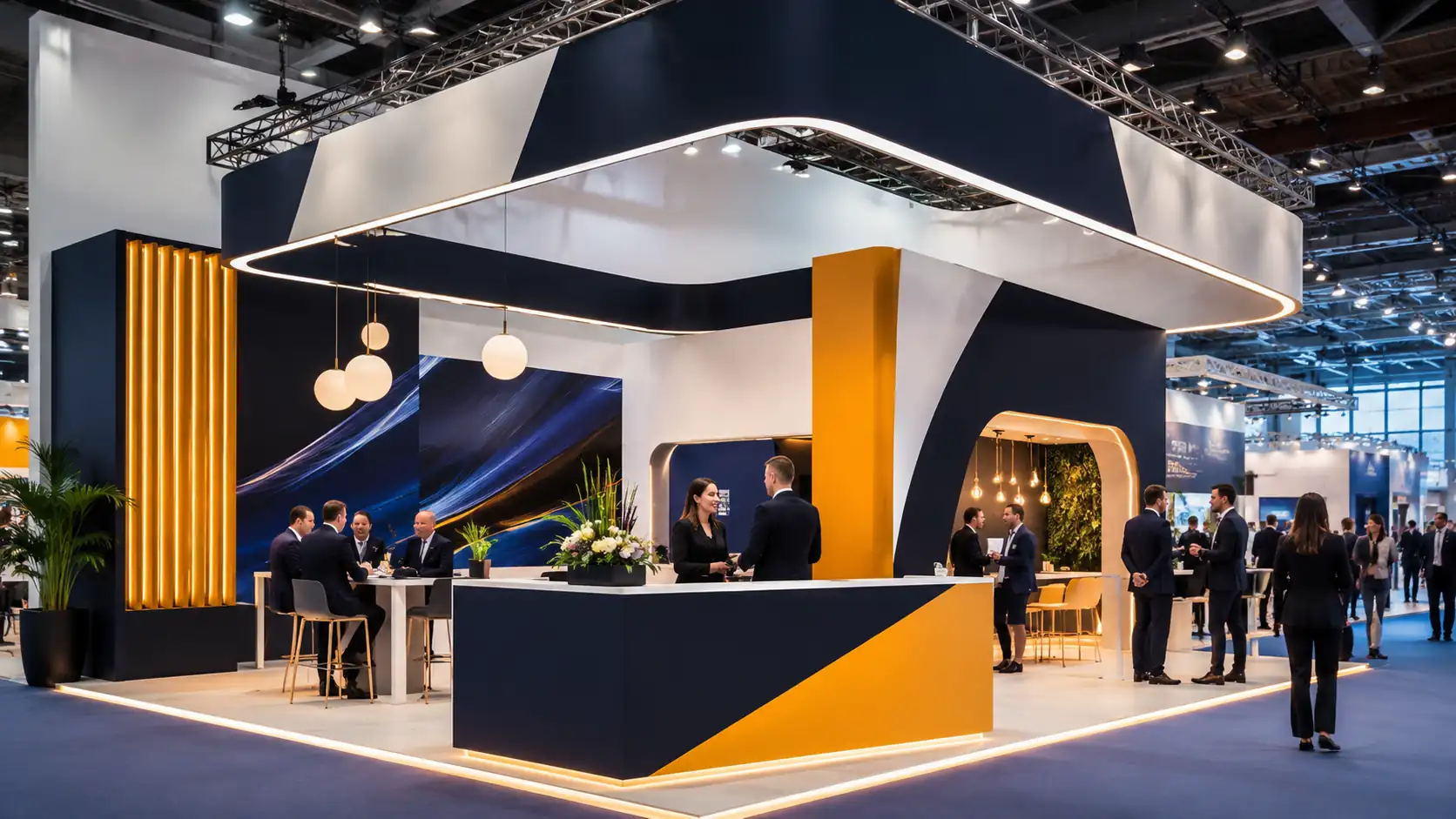
Your Booth as a Physical Expression of Your Brand
At a European trade show, your brand becomes much more than a logo, a website, or an advertising campaign. It becomes a physical environment that visitors can see, explore, and experience firsthand.
Your booth communicates long before your sales team starts a conversation. Its architecture, lighting, materials, and signage all send signals about your company’s positioning, professionalism, and capabilities.
For this reason, booth branding should never be treated as a decorative layer added at the end of the project. It should be integrated from the very beginning into the strategy, design, and booth manufacturing process.
Trade show signage plays a central role within this system. It identifies the company, organizes its messaging, and helps visitors quickly understand what it offers. However, a brand does not stand out simply by placing its logo in a prominent location.
To create a lasting impact, a booth must combine five key elements: identity, visibility, relevance, consistency, and experience. This framework connects branding with concrete decisions in design, production, and communication.
What Booth Branding Means
Booth branding (definition): the coordinated application of a brand’s identity, value proposition, and market positioning across every physical and communication element within an exhibit space.
This process influences:
- Architecture: shape, height, entrances, layout, and spatial design.
- Visual identity: colors, typography, logo, imagery, and graphic style.
- Signage: messaging, dimensional signs, vinyl graphics, and wayfinding.
- Materials: textures, finishes, and perceived quality.
- Lighting: visual hierarchy, atmosphere, and product visibility.
- Visitor experience: traffic flow, demonstrations, meetings, and interaction.
- People: staff behavior, messaging, and visitor engagement.
The goal of trade show branding is to ensure that every one of these elements communicates the same brand message.
When the booth, graphics, and sales presentation deliver different messages, inconsistency appears. Visitors often interpret this as a lack of clarity, poor planning, or limited professionalism.
A Framework for Making Your Brand Stand Out in Europe
An effective branding strategy for European trade shows can be built around five connected functions:
- Identity: define what the brand should represent.
- Visibility: ensure the booth can be easily found within the exhibition hall.
- Relevance: communicate why the brand matters to visitors.
- Consistency: maintain the same positioning across every touchpoint.
- Experience: transform the brand promise into a tangible interaction.
These principles apply both to the booth as a whole and to every individual element. A reception counter, for example, should reflect the brand identity, remain highly visible, serve a meaningful function, maintain visual consistency, and support a positive visitor experience.
Identity: Define What Your Booth Should Communicate
Before designing the space, your brand strategy must be translated into physical design criteria. Not every company should look technological, premium, sustainable, or disruptive.
The key question is: What impression should visitors take with them after leaving your booth?
To answer it, define:
- Positioning: where the company wants to stand relative to competitors.
- Primary audience: the visitors you most want to attract.
- Core promise: the value delivered to customers.
- Differentiator: the specific reason visitors should choose your brand.
- Brand personality: the attributes reflected in both design and interactions.
- Proof: evidence supporting the brand promise.
These elements become the strategic brief for the booth architecture and trade show signage.
An industrial manufacturer seeking to communicate precision requires a very different execution than a travel brand focused on emotion and hospitality. Applying the same visual solution to both would weaken their ability to differentiate themselves.
Visibility: Ensure Your Brand Gets Noticed
At large European exhibition venues, visitors encounter visual stimuli from multiple directions. Branding must work across different viewing distances and reading speeds.
Long-Distance Visibility
From main entrances and primary aisles, the priority is helping visitors locate your booth.
Common solutions include:
- Overhead dimensional signs.
- Backlit logos.
- Architectural portals or signature structures.
- Hanging banners where venue regulations allow.
- Distinctive brand color contrasts.
At this stage, lengthy messages should be avoided. Visitors should immediately recognize the brand or product category without stopping.
Medium-Distance Visibility
As visitors approach, they should quickly understand what the company offers.
Signage can communicate:
- Product or service category.
- Main benefit.
- Industry or application.
- New products introduced at the event.
Visibility Inside the Booth
Once inside, the objective changes. Wayfinding should organize products, demonstrations, meeting areas, and calls to action.
A brand truly stands out when the system works across all three levels. A highly visible logo may attract attention, but it will not generate conversations if visitors do not understand the value proposition.
Relevance: Transform Identity into a Clear Value Proposition
A booth may deliver a powerful visual impact while communicating very little. To avoid this, every message should address a specific visitor need.
An effective communication system uses three levels:
- Level 1: who the company is and what industry it serves.
- Level 2: what problem it solves or benefit it provides.
- Level 3: what evidence supports that claim.
The first level should be understood immediately. The second helps attract the right audience. The third supports meaningful sales conversations.
Proof may take many forms:
- Live product demonstrations.
- Real-world case studies.
- Relevant certifications.
- Meaningful performance data.
- Physical product samples.
- Visible production or operating processes.
Generic statements such as innovation, quality, or industry-leading solutions provide little value unless they are supported by verifiable evidence.
Consistency: Connecting Design, Manufacturing, and Trade Show Signage
Consistency exists when every booth element appears to be part of the same strategic vision.
There should be continuity between:
- The booth design and the corporate identity.
- Materials and brand positioning.
- Graphics and the sales message.
- Lighting and featured products.
- Pre-event marketing campaigns and the on-site experience.
- The physical booth and digital content.
Booth manufacturing plays a critical role. Branding depends not only on the creative concept but also on the precision of its execution.
Poorly finished joints, misaligned vinyl graphics, uneven lighting, or low-quality signage can all weaken brand perception. Visitors do not separate design from execution—they judge the entire experience as one cohesive whole.
Trade Show Signage as an Information Architecture
Trade show signage (definition): the system of visual and textual elements that identifies the brand, communicates its value proposition, and guides visitors throughout the exhibit space.
Professional signage may combine multiple solutions.
Dimensional Signs
These create depth and prominence for logos. They work especially well on overhead headers, facades, and locations visible from multiple aisles.
Fabric Graphics
Fabric graphics cover large surfaces with a seamless finish. They are lightweight, interchangeable, and ideal for reusable modular booth systems.
Printed Vinyl Graphics
Vinyl graphics are suitable for campaign messaging, product photography, wayfinding, and customized surfaces.
Backlit Panels
Backlit graphics improve visibility while creating a clear visual hierarchy for key images and messages.
Functional Wayfinding
Wayfinding identifies reception areas, demonstrations, meeting rooms, products, and services. Its primary purpose is to reduce visitor friction inside the booth.
Digital Displays
Digital screens make it easy to update content and provide detailed information. They should complement physical signage rather than replace a clear primary message.
Adapting Branding for European Trade Shows
An international brand must preserve its identity while adapting to the context of each event.
Language and Communication
English serves as the common language at many international exhibitions, but incorporating local-language content may also be beneficial.
The right approach depends on:
- Visitor origin.
- Target markets.
- Product complexity.
- Language capabilities of the booth staff.
- Commercial objectives for the event.
Translation involves more than replacing words. Every text must preserve its meaning, tone, and appropriate length for its medium.
Venue Regulations
Your brand presentation must also adapt to the technical requirements of each organizer. Height restrictions, suspended elements, lighting systems, materials, and aisle encroachment may all be regulated.
For this reason, branding concepts should always be validated before manufacturing begins. A design that relies heavily on suspended banners, for example, loses much of its effectiveness if the venue prohibits overhead structures.
Industry Differences
Visual expectations also vary by sector. Medical trade shows often prioritize clarity, cleanliness, and credibility. Technology events typically support greater dynamism and interaction. Industrial exhibitions generally require room for products, demonstrations, and technical discussions.
Your brand should preserve its core identity while adapting how it expresses that identity.
Sustainable Branding Without Vague Claims
Sustainability can support brand positioning, but it must be demonstrated through verifiable decisions.
Examples include:
- Designing reusable booth structures.
- Separating temporary graphics from permanent elements.
- Using repairable components.
- Documenting materials and suppliers.
- Optimizing packaging and transportation volume.
- Tracking the number of reuses.
- Planning the end-of-life strategy for every component.
ISO 20121:2024 provides a sustainability management framework applicable to events of different types and sizes. It addresses environmental, economic, and social impacts while linking responsible management with reputation and brand value.
European sustainable product policies are also moving toward greater emphasis on durability, reuse, repairability, and transparency. Although these policies do not require a specific booth model, they reinforce the importance of supporting environmental claims with measurable evidence.
Experience: Turning the Brand Promise into Reality
Branding extends beyond graphics. The visitor experience must demonstrate what the brand promises.
A company positioning itself as approachable needs an open booth and accessible staff. A brand promising efficiency should eliminate confusing layouts and unnecessary waiting times. A technology company should integrate technology with a clear purpose rather than simply displaying it.
The visitor experience can be organized into four stages:
- Attraction: visitors notice the brand.
- Understanding: they recognize the value proposition.
- Interaction: they engage in a conversation or demonstration.
- Continuation: they leave with a clear next step.
Every stage should reinforce the same brand positioning.
Branding Examples by Company Type
Industrial B2B Company
Identity: precision, reliability, and technical expertise.
Trade show signage: application-focused messaging, visible products, and technical proof.
Manufacturing: solid structures, clean finishes, and demonstration areas.
Experience: a direct journey from customer challenge to solution.
Technology Brand
Identity: practical innovation, agility, and ease of use.
Trade show signage: primary benefit, use cases, and dynamic content.
Manufacturing: seamless integration of displays, lighting, and concealed cabling.
Experience: short demonstrations supported by digital lead capture.
Premium Brand
Identity: exclusivity, craftsmanship, and personalized service.
Trade show signage: minimal messaging, dimensional signs, and premium photography.
Manufacturing: materials and finishes aligned with the desired perception.
Experience: personalized attention and comfortable meeting spaces.
A Step-by-Step Framework for Building a Trade Show Branding Strategy
- Step 1: define the perception your brand should create.
- Step 2: identify the event’s priority audience.
- Step 3: establish a primary value proposition.
- Step 4: select evidence that supports your message.
- Step 5: translate the strategy into architecture, graphics, and materials.
- Step 6: adapt the concept to venue regulations and booth size.
- Step 7: plan visibility across multiple viewing distances.
- Step 8: coordinate graphic design, manufacturing, and installation.
- Step 9: prepare the sales team with consistent messaging.
- Step 10: measure results and document lessons learned.
How to Measure Branding Performance at Your Booth
Brand performance can be measured by combining behavioral data, communication metrics, and commercial outcomes.
Useful indicators include:
- Stops: visitors who slow down or observe the booth.
- Entries: visitors who enter the exhibit space.
- Understanding: the ability to recognize the value proposition without lengthy explanations.
- Dwell time: the duration of interactions.
- Qualified conversations: meaningful discussions with potential customers.
- Brand recall: recognition after the event.
- Perceived consistency: alignment between the experience and the brand promise.
- Leads and meetings: commercial opportunities generated.
Attribution does not always make it possible to isolate the impact of signage from the influence of the sales team, booth location, or pre-event marketing. For this reason, comparing similar events and combining quantitative data with team observations provides a more reliable assessment.
Common Booth Branding Mistakes
- Confusing branding with displaying logos: the brand should be expressed throughout the entire experience.
- Using too many messages: this makes the primary value proposition difficult to identify.
- Prioritizing aesthetics over relevance: an attractive booth may still fail to communicate effectively.
- Designing without considering manufacturing: this increases revisions, costs, and inconsistencies.
- Literal translation: can produce unnatural or overly long messaging.
- Ignoring booth location: branding should respond to real aisles, viewing angles, and distances.
- Using technology without purpose: adds complexity without improving the visitor experience.
- Failing to train the team: people are an essential part of brand communication.
- Making environmental claims without evidence: reduces credibility.
- Failing to measure performance: prevents continuous improvement.
How Full-Expo Can Strengthen Your Brand Across Europe
Full-Expo integrates branding throughout the booth design, production, and installation process.
This approach may include:
- Trade show strategy analysis: audience, positioning, and expected outcomes.
- Custom booth design: architecture aligned with your corporate identity.
- Booth manufacturing: precision production of structures, furniture, and custom elements.
- Trade show signage: vinyl graphics, fabric graphics, wayfinding, dimensional signs, and illuminated displays.
- Technology integration: lighting, digital displays, and audiovisual systems.
- International adaptation: booth configurations for multiple European exhibitions.
- Installation and dismantling: on-site technical coordination.
- Reuse planning: preparing components for future events.
Coordinating design, manufacturing, graphics, and installation reduces inconsistencies while ensuring that the identity established in the strategic brief is faithfully reflected at the event.
Conclusion: A Brand Stands Out When Every Part of the Booth Tells the Same Story
Trade show branding does not depend on a single visual element. It emerges from the relationship between identity, visibility, relevance, consistency, and experience.
Identity defines what the company represents. Visibility makes it easy to find. Relevance explains why visitors should care. Consistency connects design with execution. Experience transforms the brand promise into a meaningful interaction.
Booth manufacturing turns strategy into a physical environment. Trade show signage organizes information and strengthens recognition. The sales team completes the experience by transforming attention into business opportunities.
At European trade shows, where companies from many countries compete within the same exhibition halls, standing out is not simply about occupying more space. It is about communicating more effectively while maintaining a recognizable brand identity at every touchpoint.
Full-Expo can help you develop a booth that integrates architecture, production, and communication to represent your brand with clarity at trade shows and conferences across Europe.
Request a quote from Full-Expo and transform your next booth into a consistent, highly visible, and commercially effective expression of your brand.
Frequently Asked Questions About Booth Branding and Trade Show Signage (FAQs)
It is the coordinated application of a brand’s identity and positioning across the booth’s architecture, graphics, materials, communication, and visitor experience.
Combine long-distance visibility, a clear value proposition, readable signage, distinctive architecture, and a visitor-focused experience.
Signage should include the brand, product or service category, primary benefit, and clear directions to products, demonstrations, or meeting areas.
Branding defines the overall perception of the company. Trade show signage is the visual system that identifies, informs, and guides visitors throughout the booth.
Review the language, audience, venue regulations, business objectives, booth location, and industry expectations while preserving the brand’s core identity.
There is no universal answer. The best colors are those that align with the corporate identity while providing strong contrast and excellent readability under exhibition lighting.
Because precision, materials, and finishes directly influence perceived quality and determine whether the design is executed consistently.
Yes. Structures, dimensional signs, and other permanent elements can be reused, while graphics and messaging are updated for each event.
Track booth traffic, visitor entries, dwell time, message comprehension, brand recall, qualified leads, and meetings generated.
It should be defined at the beginning of the project, before finalizing the architecture, materials, graphics, and production, to avoid inconsistencies and costly revisions.